
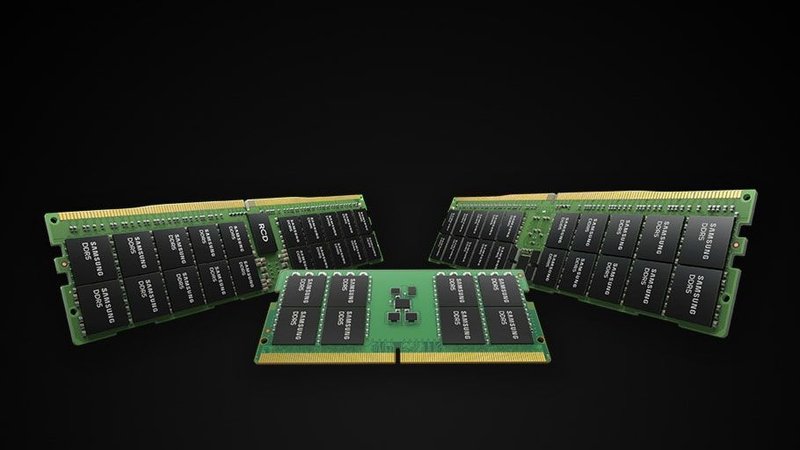
The SEMI association has raised its voice toward the Trump administration: meddling with the memory market risks triggering severe repercussions across the entire semiconductor chain. The appeal — reported by Bloomberg — comes at a time when any shift in the price or availability of DRAM, NAND, and high-bandwidth memory (HBM) immediately affects those building systems for AI workloads, from GPU servers to edge nodes.
Behind every locally running LLM, the role of memory is often underestimated. Inference, and even more so fine-tuning, devour bandwidth and capacity: quantized models push VRAM limits, while HBM determines how quickly tokens can be processed. It’s no coincidence that the most sought-after boards for on-premise deployment — from NVIDIA H100s to AMD offerings — are evaluated as much for their compute cores as for their gigabytes of fast memory and available bandwidth.
Any potential introduction of tariffs, export restrictions, or other protectionist measures — a scenario the industry fears — would deal a double blow to organizations that have chosen or are evaluating a self-hosted path: higher procurement costs and supply continuity uncertainty. From a TCO perspective, memory cost significantly impacts servers hosting LLMs, especially when scaling to multi-GPU configurations for extended context windows or serving multiple models in parallel.
SEMI’s warning does not stand alone. The entire memory production chain is highly globalized: chips are designed on one continent, manufactured on another, tested and assembled elsewhere. Any regulatory friction risks breaking this equilibrium, with cascading effects on availability and pricing. For teams assessing on-premise deployment, this means adding a geopolitical variable to already complex infrastructure calculations. A cluster planned to run Llama 3 or Mistral locally, with data sovereignty guarantees, could suddenly see hardware costs spike or lead times stretch.
Those designing air-gapped or hybrid inference architectures know well that memory is no ordinary commodity: it is the bridge between data and model weights. And in a landscape where cloud-based alternatives raise GDPR compliance and control questions, hardware supply chain predictability becomes a prerequisite. SEMI’s appeal, therefore, concerns not only large semiconductor manufacturers but anyone invested in the economic and operational viability of running advanced AI in their own data centers.







💬 Comments (0)
🔒 Log in or register to comment on articles.
No comments yet. Be the first to comment!