
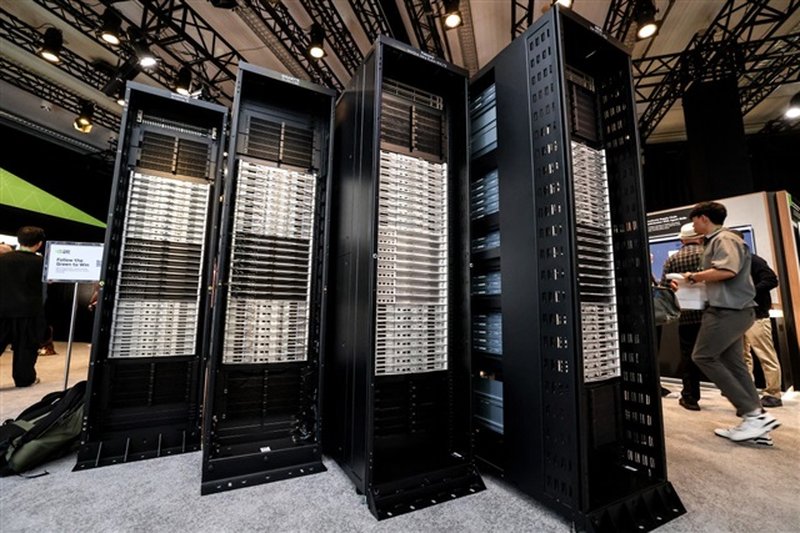
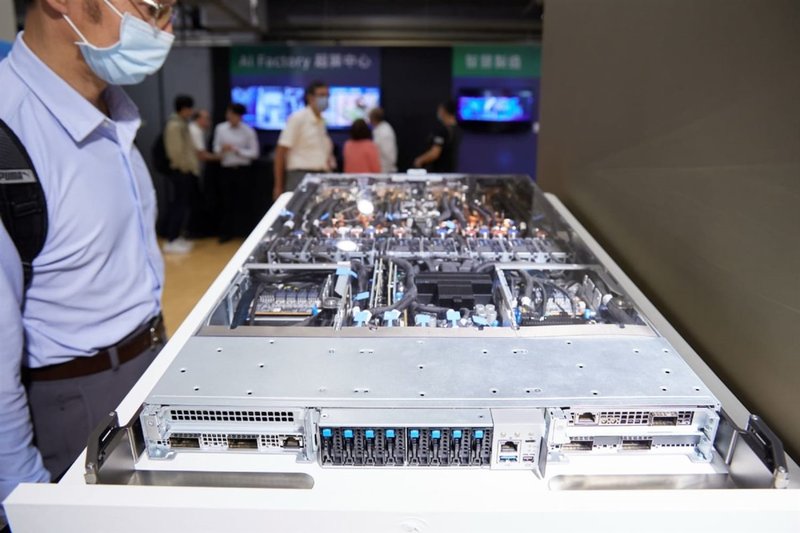
In the third quarter of 2026, Foxconn’s AI server shipments tell a story of compute demand that no longer moves at a single pace. Systems built around ASICs reached 1.5 times the volume of the same period a year earlier; GPU servers grew 70%. The two figures, reported by Digitimes, do more than capture a positive quarter: they show how infrastructure for Large Language Models is splitting into two markets with different underlying logics.
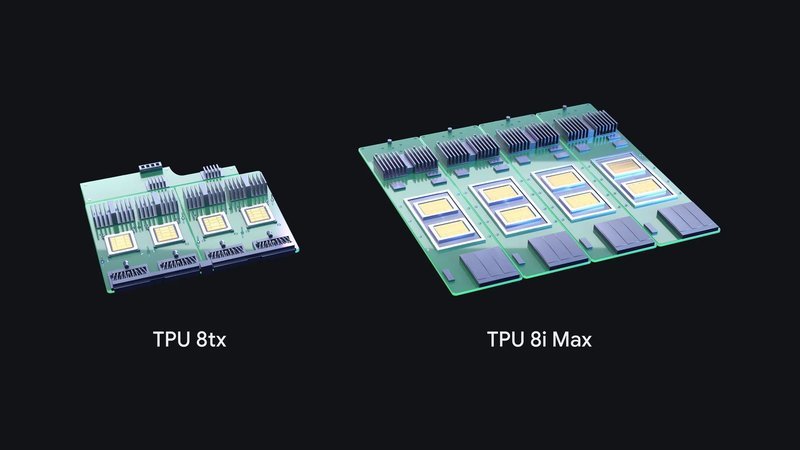
Foxconn is a contract manufacturer: it does not design the chips, but assembles servers for hyperscalers and large cloud providers. The increase in ASIC shipments therefore reflects purchasing decisions already made upstream, often tied to large-scale inference workloads where cost per token and energy efficiency matter more than flexibility. An ASIC can be optimized for a narrow class of operations and, within that perimeter, consume less energy and cost less per unit of work than a general-purpose GPU. The GPU, however, retains a decisive advantage when the workload shifts frequently, when teams need to experiment with different models, or when fine-tuning and development require a mature software ecosystem.
The gap between the two growth rates has second-order implications. For large cloud providers, pushing more volume onto ASICs reduces dependence on a single accelerator supplier and gives greater control over the unit economics of inference services. For a manufacturer like Foxconn, ASIC growth brings revenue, but also a tighter link to the roadmaps of a few customers: margins, volumes and risks become concentrated around specific programs, unlike the more liquid market for GPU servers. For organizations running their own infrastructure, the message is that comparing accelerators is no longer just a matter of GPU generations. It means mapping the workload: a stable, high-volume inference pipeline can have a very different Total Cost of Ownership from a research environment that changes models every month.
There is also a third-order effect. If the share of capacity dedicated to specialized inference keeps growing, the installed base becomes more heterogeneous: no longer only interchangeable GPUs, but a combination of general-purpose and custom silicon. That makes software portability, runtime quality and the ability to move a model from one accelerator to another without rewriting the entire pipeline more important. Organizations evaluating on-premise deployment need to reason not only about peak performance, but also about these management and lock-in costs. AI-RADAR provides analytical frameworks at /llm-onpremise to compare the trade-offs without oversimplification.
Ultimately, the Foxconn data does not say that GPUs are losing relevance: 70% growth remains strong. It says that the next wave of AI capacity will increasingly be built around specific workloads, with hardware designed for a task. For the industry, it is a sign that the accelerator market is becoming mature, differentiated and less predictable in the balance of power among suppliers.




💬 Comments (0)
🔒 Log in or register to comment on articles.
No comments yet. Be the first to comment!