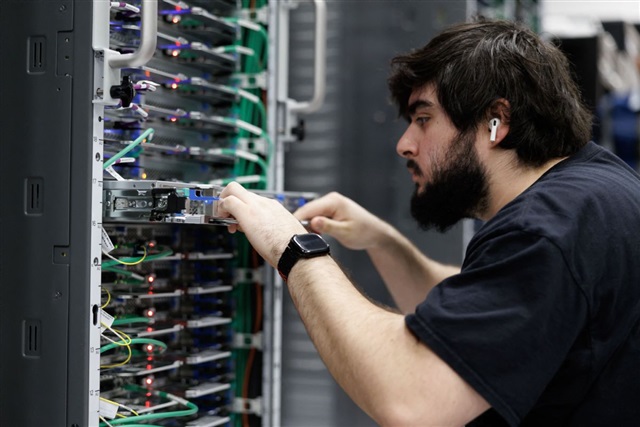
Taiwan's Expanding AI Server Supply Chain
The global artificial intelligence landscape continues to generate unprecedented demand for dedicated hardware infrastructure. In this context, Taiwan is emerging as an increasingly central player, consolidating its position in the AI server supply chain. Recent analyses indicate a clear expansion of this supply chain, with a particularly notable finding: rack suppliers are outperforming other segments of the industry in terms of growth.
This trend not only underscores the island's production capacity but also its strategic importance for the entire AI ecosystem. The growing demand for servers optimized for Large Language Models (LLM) workloads and other artificial intelligence applications is driving companies to invest in robust and high-performance hardware solutions, often with a focus on on-premise deployments.
The Critical Role of Rack Suppliers in AI Infrastructure
AI servers are not simple machines but complex systems integrating a wide range of high-performance components, from specialized GPUs (such as NVIDIA H100s or AMD Instinct MI300X) to CPUs, from high-bandwidth VRAM to high-speed interconnect systems like NVLink. In this scenario, rack suppliers play a fundamental role. They are not limited to producing chassis but are responsible for the assembly, integration, and validation of entire server units, ensuring that all components work in synergy to maximize throughput and minimize latency.
Their superior performance indicates a maturation and specialization of the supply chain, capable of meeting the specific needs of AI workloads, which require significantly higher compute density and cooling capacity compared to traditional servers. This specialization is crucial for companies looking to build or expand their self-hosted AI infrastructure, where every element, from computing power to thermal management, directly impacts efficiency and Total Cost of Ownership (TCO).
Implications for On-Premise Deployments and Data Sovereignty
The expansion and specialization of the Taiwanese supply chain have direct implications for organizations evaluating on-premise deployments for their AI workloads. The availability of pre-integrated and optimized AI servers from reliable suppliers is an enabling factor for strategies that prioritize data sovereignty, regulatory compliance (such as GDPR), and security in air-gapped environments. Opting for self-hosted solutions allows companies to maintain full control over their data and models, avoiding the complexities and potential risks associated with public cloud services.
However, this choice also involves significant trade-offs. The initial investment (CapEx) for purchasing high-end hardware, infrastructure management, and the allocation of resources for maintenance and upgrades are aspects that need careful consideration. The strength of the Taiwanese supply chain can help mitigate some of these costs by offering more competitive options and greater component availability. For those evaluating on-premise deployments, there are significant trade-offs between initial costs, operational management, and long-term benefits in terms of control and security. AI-RADAR offers analytical frameworks on /llm-onpremise to evaluate these choices.
Future Prospects and Challenges for the AI Supply Chain
The demand for AI servers is set to grow further, driven by continuous innovation in Large Language Models and the adoption of artificial intelligence in increasingly broad sectors. The ability of the Taiwanese supply chain to maintain its momentum and adapt to new technological requirements will be crucial. Challenges include supply chain resilience in the face of geopolitical events or global disruptions, the need for constant investment in research and development to support future generations of chips and architectures, and managing the environmental impact associated with the energy consumption of these infrastructures.
In this dynamic scenario, the robustness of the AI server supply chain, with its specialized players like rack suppliers, remains a fundamental pillar for the evolution of artificial intelligence. For companies aiming to build a robust, secure, and controlled AI infrastructure, understanding these market dynamics is essential for making informed strategic decisions.







💬 Comments (0)
🔒 Log in or register to comment on articles.
No comments yet. Be the first to comment!