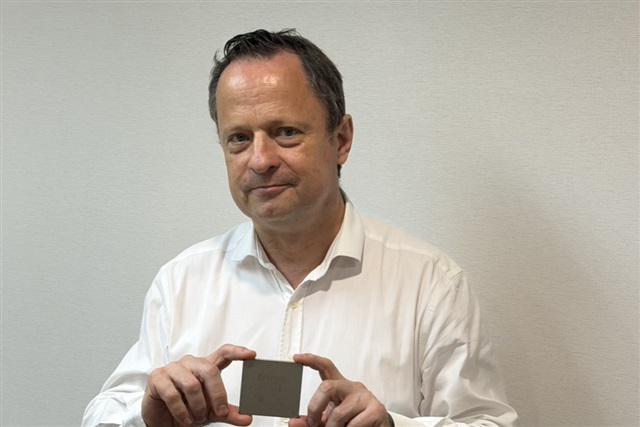
SiPearl founder and CEO Philippe Notton chose Taipei to announce the next step: bringing servers based on the Rhea1 processor to market by partnering with Taiwanese ODMs. The decision reveals far more than it seems about Europe’s real ability to build an independent hardware supply chain — a critical concern for those evaluating on-premise infrastructure for AI workloads today.
The scene is an exclusive interview with DIGITIMES. In Notton’s hands is a sample of Rhea1, the chip that carries Europe’s high-performance computing ambitions and, by design and architecture, could become a building block for on-premise AI inference. Born within the European Processor Initiative, Rhea is an ARM-based processor aimed at exascale, with the goal of reducing the continent’s dependence on silicon from the U.S. and Asia in strategic data centers.
Yet the road to technological autonomy is full of paradoxes. To manufacture servers, SiPearl knocked on the door of Taiwan’s major ODMs — the same companies that already produce most systems for global cloud and AI giants. It’s a pragmatic, almost forced choice: without the manufacturing capacity and system integration that only the Taiwanese ecosystem can deliver within reliable timelines, the product risked remaining on paper. But here lies the contradiction. If the hardware running in an on-premise data center, perhaps training or serving an LLM with full data sovereignty, is assembled and tested in Asia, who really controls the supply chain? And what security and compliance guarantees (think GDPR, critical infrastructure requirements) can a machine offer when its production path crosses sensitive geopolitical borders?
For enterprises and public administrations looking at local deployment as a shield against cloud risks, the question is far from theoretical. Technical specifications matter, but transparency of the supply chain, hardware integrity verification, and the ability to audit every link matter even more. The SiPearl–Taiwan deal shows that Europe can design competitive chips, but server manufacturing remains a bottleneck. It’s a structural signal: until the continent invests in assembly and testing lines at scale, sovereignty will remain a half-finished concept, with design in Brussels and hardware in Taipei.
In this tension, SiPearl’s move is not a defeat but an acknowledgement of an industrial limit that no technology policy initiative can ignore. Anyone evaluating on-premise infrastructure for LLMs today must weigh this scenario: having “European” chips does not automatically mean having fully controlled servers. As Rhea1 prepares to enter the market, the real challenge will be building a production ecosystem around that silicon that does not, every time, force a reckoning with a paradox.





💬 Comments (0)
🔒 Log in or register to comment on articles.
No comments yet. Be the first to comment!