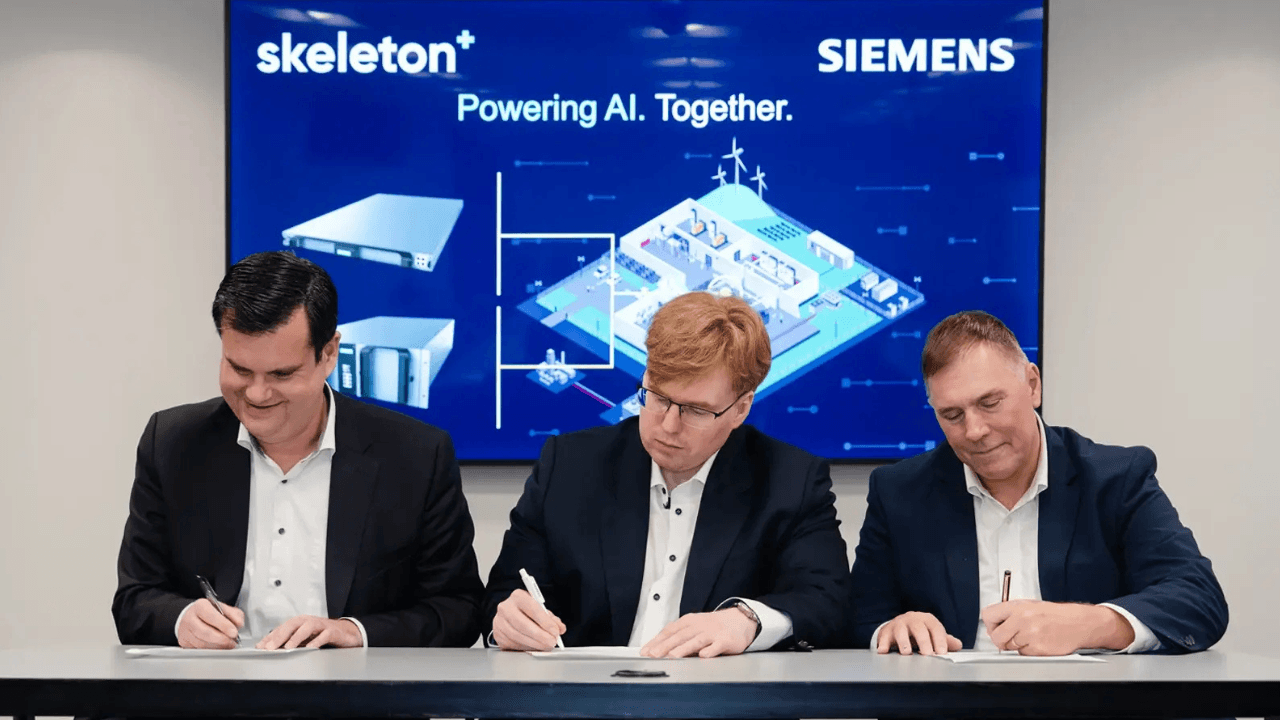
Siemens pushing Skeleton Technologies past a $1 billion valuation is not just a financial milestone. It is a signal that the real constraint in AI is shifting from GPU supply to the quality and stability of the power feeding those chips. The deal, a nine-digit investment round led by Siemens, accelerates Skeleton's US manufacturing expansion and R&D in Silicon Valley. Skeleton builds high-power systems based on supercapacitors made from its proprietary Curved Graphene material, designed to absorb load swings in GPU clusters that can shift between power states within milliseconds, creating peaks, harmonics and rapid fluctuations.
The International Energy Agency expects global data centre electricity consumption to nearly double from about 485 TWh in 2025 to 950 TWh by 2030, while electricity use by AI-focused data centres is expected to triple. It is not only about volume: AI workloads change how power is drawn. Traditional power conditioning and protection equipment is not designed for such fast transients. Skeleton says its cells, combined with power electronics and system-level controls, eliminate harmonics and manage rapid fluctuations close to the workload, delivering up to 40 percent energy savings and double-digit improvements in GPU performance.
CEO Taavi Madiberk's thesis is blunt: "AI is scaling faster than the power infrastructure behind it. The constraint is not how many GPUs you can buy, but how much compute you can extract from every GPU and every megawatt." That shifts the centre of gravity. If supercapacitors become "the new semiconductors", as Madiberk puts it, then competition is not only about who builds the fastest chips, but who can ensure those chips operate at their full potential. In a data centre, a power dip or harmonic can degrade performance or shorten equipment life. A system that responds in milliseconds changes the TCO calculation: it is not just about paying less for electricity, but getting more useful work from the same physical infrastructure.
The Siemens deal is not purely financial. Siemens had already supported Skeleton's expansion in 2023, and Siemens Digital Industries designed and automated the company's Leipzig SuperFactory in Germany. Now the two firms plan to combine Siemens' industrial electrical infrastructure with Skeleton's fast-response power systems to develop products for next-generation data centres, addressing hyperscaler demand "from the grid to the rack".
The US expansion plan, with more than $200 million for operational scale-up and R&D in Silicon Valley, aims to create a fully integrated US value chain from cells to complete systems. This responds to two pressures: proximity to large AI infrastructure customers in the United States, and the push for supply chain resilience and technological sovereignty in critical infrastructure. Skeleton says it will be the only player in its segment with a full US value chain.
The second-order implications matter. If power conditioning systems can deliver double-digit GPU performance improvements and 40 percent energy savings, then power quality and energy efficiency become a competitive lever that can decide whether a data centre is profitable or marginal. For readers evaluating self-hosted or on-premise deployments for LLM workloads, the message is concrete: electrical infrastructure is not a building detail, but part of the stack. The promise of "more compute from the same megawatt" changes how hardware and facility investments are assessed, shifting attention from chips alone to the power delivery chain. For those comparing on-premise and cloud deployment, AI-RADAR offers analytical frameworks at /llm-onpremise to examine these trade-offs.
Siemens' entry as lead investor is telling. The partnership signals a convergence between industrial automation and AI infrastructure: whoever controls power distribution and quality can become a critical enabler of compute capacity. GPU makers do not lose relevance, but the bottleneck moves upstream. For Skeleton's competitors in supercapacitors or power quality systems, the bar rises: an integrated US value chain and a Siemens partnership create a barrier that is difficult to replicate quickly.
Ultimately, the Skeleton-Siemens deal is more than a financial story. It is a structural indicator that the next wave of AI data centres will be defined not only by chip density, but by the ability to feed those chips with stable, efficient, locally controlled power. Those who master power transients will have an asymmetric advantage, because they can extract more value from every GPU and every megawatt. The challenge now is turning the supercapacitor promise into scaled production, and Skeleton's US move is precisely that attempt.







💬 Comments (0)
🔒 Log in or register to comment on articles.
No comments yet. Be the first to comment!