
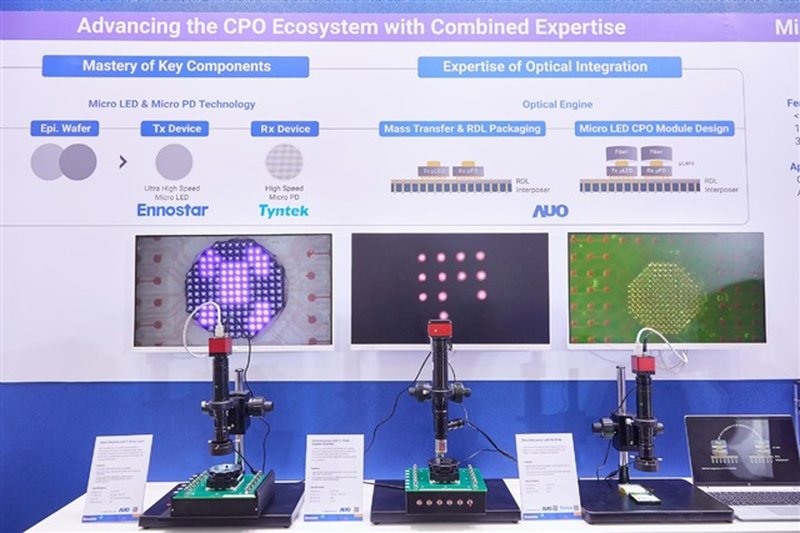
SmartSens is preparing to bring a technology born for displays into the data centers that power Large Language Models. The company has announced its aim to commercialize Micro LED-based optical interconnects for AI infrastructure by 2027, a segment currently dominated by silicon photonics and VCSEL solutions. The choice is not trivial: Micro LEDs promise very high luminous efficiency, lower production costs at scale, and ease of integration that could lower the barrier for extreme-bandwidth connections within racks.
The news comes at a time when communication bottlenecks between GPUs are throttling distributed inference and training. With models surpassing hundreds of billions of parameters, interconnect bandwidth becomes as critical as raw compute power. Today NVLink, InfiniBand, and traditional optical connections offer high performance, but at energy costs and implementation complexity that not all environments can sustain, especially those managing on-premise clusters with tight budgets and TCO constraints.
SmartSens is no stranger to image sensors, but using Micro LED arrays as light sources for data transmission marks a leap into intra-data center networking infrastructure. Unlike VCSELs, Micro LEDs can be manufactured using mature display industry processes, promising cost reduction and greater flexibility in optical channel layout. This could translate into interconnects with higher density and lower power consumption, two parameters that directly affect the economic sustainability of AI clusters, whether cloud or on-premise.
Why 2027 is a strategic date
The timeline is not accidental. Current silicon photonics roadmaps will see significant volumes by mid-decade, while demand for AI infrastructure grows at a pace that existing solutions cannot sustain. SmartSens is positioning its Micro LEDs as a mature alternative just in time for the next generation of training clusters, when compute nodes will be even more bandwidth-hungry. For those planning the renewal of their on-premise infrastructure today, this announcement signals that within a few years the competitive landscape for optical interconnects could change radically, potentially rendering obsolete current bets on proprietary technologies.
Who wins and who loses
Major optical module and switch manufacturers (Broadcom, Intel, NVIDIA via its acquisitions) have so far called the shots. A credible entry from the display semiconductor world could break the current oligopoly, pushing toward more open standards and a general reduction in prices. System integrators and companies that run their own compute capacity on-site, often excluded from the hyperscalers’ economies of scale, would stand to benefit especially. On the other hand, those who have invested heavily in existing solutions could find themselves with less competitive assets in the medium term—a risk not to be underestimated when amortization cycles stretch over years.
The adoption of Micro LEDs in optical interconnects has yet to be proven in the field, but SmartSens’ announcement is a clear indicator: the battle for the AI data center backbone has just entered a phase of technological discontinuity that will spare no one.








💬 Comments (0)
🔒 Log in or register to comment on articles.
No comments yet. Be the first to comment!