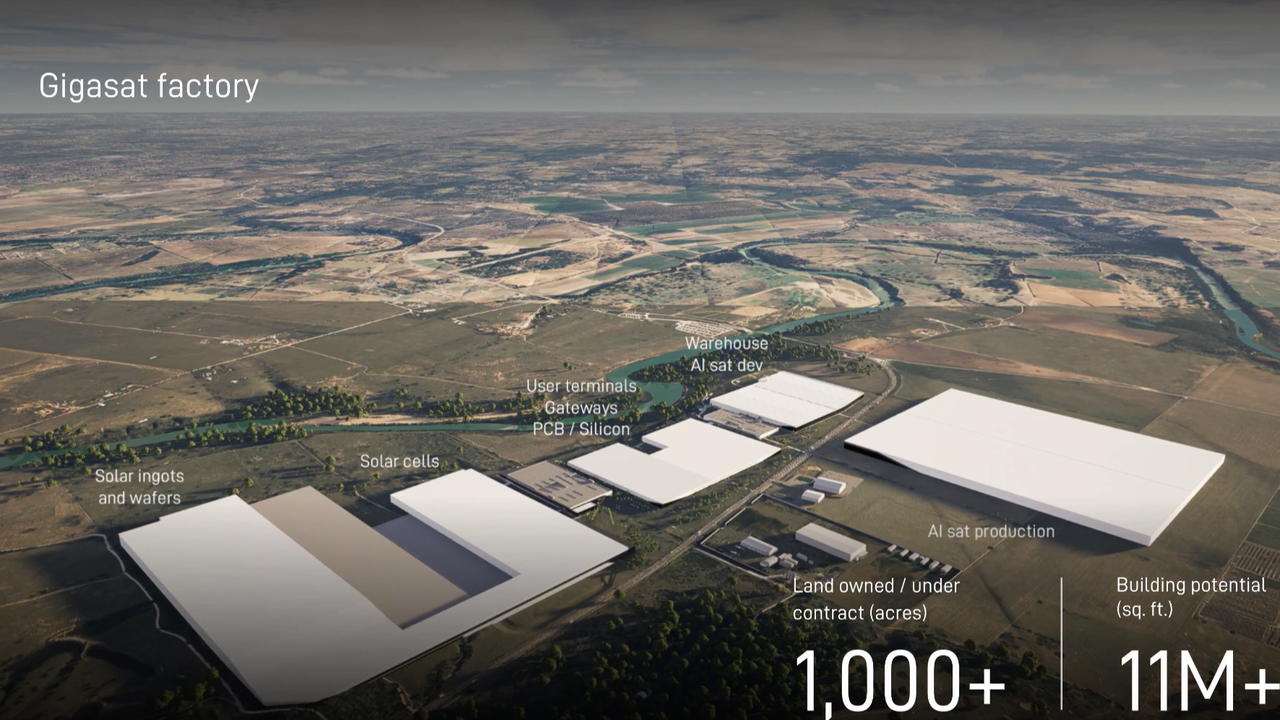
SpaceX Unveils Gigasat: A Factory for Space-Based AI
SpaceX has announced the construction of the Gigasat factory, an impressive 11-million-square-foot facility dedicated to manufacturing space-based data centers. This initiative marks an ambitious expansion in the field of artificial intelligence computing infrastructure, with the stated goal of generating 1 GW of AI compute power per year from its satellites by late 2027. The announcement positions SpaceX as an emerging player not only in space launches but also in providing global-scale AI compute capabilities, with significant implications for the future of model and service deployment.
The magnitude of the project, both in terms of factory size and projected compute power, underscores the growing demand for computational resources for AI. The vision of orbiting data centers raises interesting questions regarding data sovereignty, latency, and energy efficiency—crucial elements for companies evaluating deployment strategies alternative to traditional cloud services.
Technical Implications for Space AI
The promise of 1 GW/year of "space AI compute" from satellites by 2027 opens up unprecedented scenarios for the deployment of Large Language Models (LLM) and other artificial intelligence workloads. Traditionally, running AI models requires robust terrestrial infrastructures with high requirements for VRAM, compute power (GPUs), and heat dissipation. Bringing these capabilities into space involves addressing complex engineering challenges, from the miniaturization and radiation hardening of silicon to thermal management in the absence of convection.
Such a deployment might focus on inference workloads, where pre-trained models are used to generate outputs, rather than intensive training, which demands even greater resources and more frequent interaction with large datasets. However, the ability to perform even light fine-tuning tasks or real-time data processing directly in orbit could offer unique advantages for applications that benefit from physical proximity to space-based sensors or data sources.
Deployment Context and TCO
SpaceX's approach, while not an on-premise deployment in the classical sense, shares with it the philosophy of direct control over infrastructure and data sovereignty. For CTOs and infrastructure architects, the evaluation of self-hosted or air-gapped solutions is often driven by the need to keep data within specific boundaries or to ensure granular control over the execution environment. Space-based AI infrastructure could offer a new paradigm for data sovereignty, especially for governmental entities or companies with stringent compliance requirements operating globally.
The Total Cost of Ownership (TCO) for such an initiative is clearly high in terms of initial CapEx for factory construction, satellite development, and launches. However, in the long term, it could present a different operational model compared to recurring cloud costs, especially for massive and persistent AI workloads. The ability to manage the entire production and deployment pipeline, from silicon to satellite, gives SpaceX vertical control that can optimize the efficiency and security of the entire value chain.
SpaceX's Vision and the Future of AI
SpaceX's move with the Gigasat factory and the goal of 1 GW of space AI by 2027 is not just a technological expansion but a strategic statement about the future of computing infrastructure. It suggests a vision where AI capabilities are no longer confined to traditional terrestrial server farms but can be distributed capillarily and autonomously in orbit. This could enable a new generation of services and applications that require distributed, low-latency AI processing or have security and data sovereignty requirements that terrestrial solutions struggle to meet.
For companies navigating the complexities of deploying LLMs and other AI models, the emergence of such radically different options underscores the importance of carefully evaluating the trade-offs between cloud, on-premise, and, in the future, perhaps even space-based solutions. AI-RADAR continues to explore these scenarios, providing analytical frameworks on /llm-onpremise to support informed decisions on the constraints and opportunities of each approach.





💬 Comments (0)
🔒 Log in or register to comment on articles.
No comments yet. Be the first to comment!