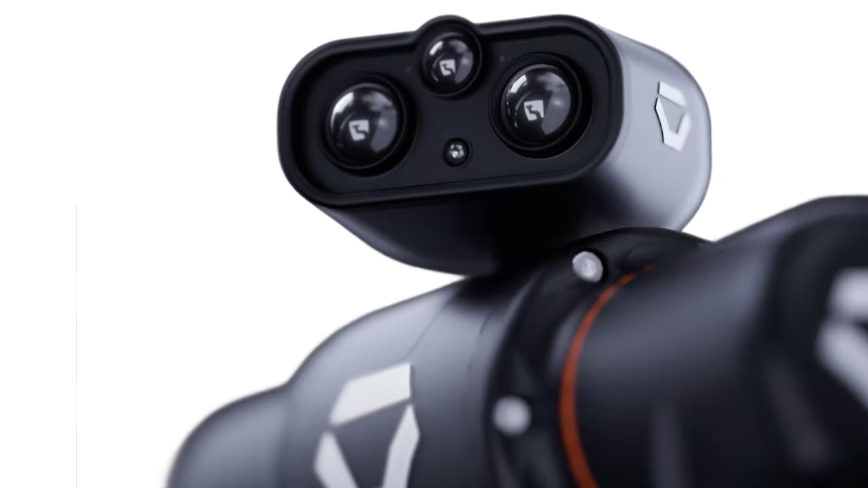
A New Funding Round for Industrial Automation
Standard Bots, a New York-based company specializing in robotic arms for industrial automation, has announced a significant funding round of $200 million. The operation, which valued the company at one billion dollars, was led by General Catalyst and RoboStrategy, a robotics-focused fund. This new capital follows a previous $63 million round, closed nearly two years ago at an undisclosed valuation.
These funds will be used to boost the production of advanced, AI-powered robotic arms in the United States. The primary goal is to expand manufacturing capacity to meet the growing demand for automation solutions across various industrial sectors. The investment underscores investors' confidence in Standard Bots' potential to solidify its position in the global robotics market.
Manufacturing Expansion and Market Implications
Standard Bots' stated goal is ambitious: to handle 10% of industrial deployments by the end of the year. This expansion of manufacturing capacity in the United States reflects a broader trend towards supply chain resilience and localized production control, aspects that are increasingly critical in the current economic landscape. The choice to produce domestically can offer strategic advantages, reducing dependence on foreign suppliers and ensuring greater flexibility.
For companies operating in critical sectors, domestic production can offer benefits in terms of security, regulatory compliance, and reduction of geopolitical risks. Industrial automation, particularly with the integration of AI, is a key factor in improving operational efficiency and competitiveness. Standard Bots' ability to scale the production of AI robotic arms in the United States could therefore have a significant impact on the modernization of factories and assembly lines nationwide.
The Role of AI in On-Premise Automation
Although the source does not specify the technical details of the artificial intelligence employed by Standard Bots, industrial automation with robotic arms often relies on computer vision systems and machine learning models operating in edge or on-premise environments. For manufacturing companies, the decision to deploy AI solutions on-premise is often driven by low-latency requirements, essential for real-time operations, and the need to maintain data sovereignty over sensitive production data.
These contexts often demand robust infrastructures capable of handling intensive workloads directly in the factory, sometimes in air-gapped environments to maximize security and compliance. Managing the TCO (Total Cost of Ownership) for such deployments is crucial, considering initial hardware costs, energy, and maintenance. AI-RADAR regularly analyzes the trade-offs between self-hosted and cloud solutions for AI/LLM workloads, providing analytical frameworks on /llm-onpremise to evaluate TCO and specific requirements for data sovereignty and infrastructure control.
Future Prospects and Deployment Challenges
The industrial automation sector is experiencing a phase of rapid evolution, driven by the integration of increasingly sophisticated AI technologies. The investment in Standard Bots underscores market confidence in the potential of intelligent robotic arms to transform production processes, making them more efficient, flexible, and secure. A robot's ability to learn and adapt to new tasks thanks to AI is a game-changer for many industries.
Significant challenges remain, from deployment scalability to managing technological complexity and integrating with existing systems. However, the drive for efficiency and innovation continues to fuel investments in this area. Standard Bots' promise to handle a significant share of industrial deployments by the end of the year positions the company as a key player to watch in the AI-powered automation landscape.






💬 Comments (0)
🔒 Log in or register to comment on articles.
No comments yet. Be the first to comment!