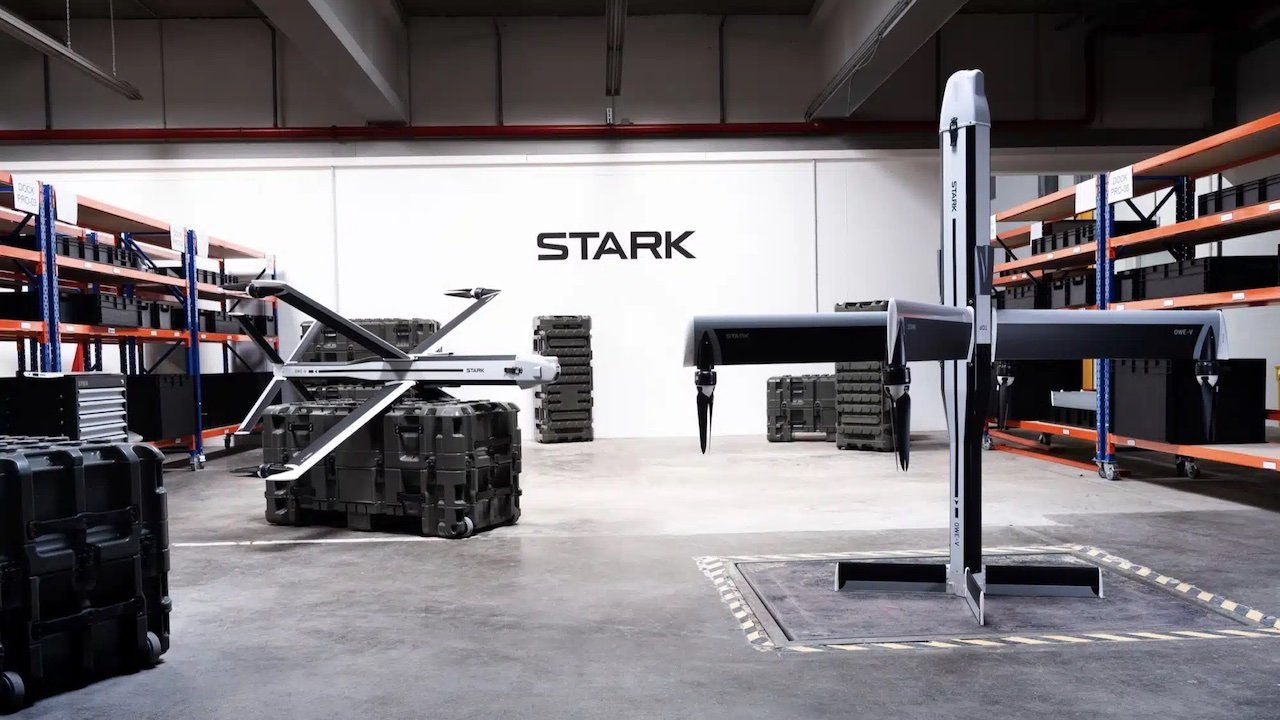
This is not just one of the largest rounds ever recorded in European defense tech. The €500 million funding just secured by Stark — a German startup founded in 2024 and already valued at €3.5 billion — is redrawing the continent’s industrial agenda. Sequoia, Founders Fund, the NATO Innovation Fund, and other heavyweights are among the investors, signaling that European military technology has entered a maturity phase and is attracting capital on a global scale. Founder and CEO Uwe Horstmann put it bluntly: «The challenge facing Europe is no longer whether we can innovate, it’s whether we can scale. This financing is a €500 million commitment to Europe’s defense industrial base».
What the €500 million will fund
Stark specializes in weaponized drones, but today’s announcement makes clear that the capital will not just feed production lines. Over 80% of the sum will go directly into R&D and manufacturing. Specifically, the funds will build new electronic warfare research facilities, scale production output, and — crucially — «accelerate the development of sovereign defence capabilities». That last detail turns an investment into a technology policy case. It’s not about buying off-the-shelf solutions; it’s about building an ecosystem of expertise, supply chains, and industrial plants that remain under European control.
Sovereignty: from defense to AI infrastructure
The stress on “sovereignty” overlaps with many concerns animating those who manage critical technology infrastructure today. The parallel with artificial intelligence is immediate: just as Stark aims to make the design and production of weapons systems autonomous, a growing number of organizations are pushing to run LLMs and inference pipelines on local stacks, free from dependence on foreign clouds. Concepts like control, data residency, and auditing take on the same priority that the defense industry assigns to intellectual property protection and communications security.
For those evaluating on-premise deployment scenarios, the Stark story is a directional signal. Sovereign and institutional funds (here represented by the NATO Innovation Fund) are not just financing hardware: they are betting on an ecosystem’s ability to design, test, and produce in-house. Similarly, anyone deploying large language models inside an enterprise knows the choice is not only about GPUs, but the entire chain: orchestration frameworks, fine-tuning on proprietary data, quantization to optimize available VRAM, and continuous audit processes for GDPR compliance.
The role of institutional capital
The presence of investors like Sequoia and Founders Fund alongside the NATO fund reveals an ever-tighter entanglement of venture capital, defense, and dual-use technologies. While not entirely new, the size of the round — and the resulting valuation — shows the sector is leaving its niche. The demand for “tech sovereignty” is becoming a market in its own right, with multi-year TCO calculations and a focus on supply-chain resilience. In Europe, this also means nurturing a local base of advanced electronic component suppliers, a factor that will affect procurement for anyone building AI data centers.
Implications for on-premise AI developers
Although Stark is not an AI software company, its trajectory has indirect but tangible consequences for the self-hosted LLM world. The push into electronic warfare will create new labs and testbeds that could generate know-how reusable in high-reliability edge computing. Moreover, the drive to produce strategic components (boards, sensors, radio modules) in Europe might ease the supply bottlenecks currently afflicting GPU procurement. It is not science fiction: several sovereign AI projects already tap defense funds to build air-gapped inference clusters where security is not an option but a regulatory requirement.
The challenge remains the one Horstmann pointed to: scaling. Moving from prototypes to production lines, from proof-of-concept to infrastructure handling real workloads. AI teams know this problem well: it’s one thing to run a quantized model on a single machine, quite another to deploy it on-premise with guarantees of latency, throughput, and security. Stark’s experience — and the capital behind it — may indicate that Europe has decided to get serious about building an indigenous industrial base, not just for drones, but for the entire spectrum of strategic technologies.







💬 Comments (0)
🔒 Log in or register to comment on articles.
No comments yet. Be the first to comment!