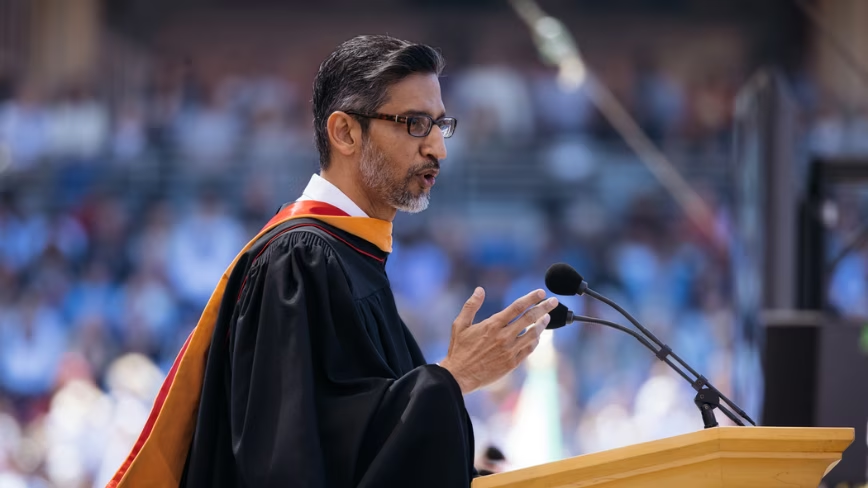
An Unexpected Address from Google's CEO
On Sunday, June 14, in Stanford Stadium, Sundar Pichai, CEO of Google and Alphabet, delivered the address for Stanford University's 135th commencement ceremony. The event took an unexpected turn, considering Pichai's role at the helm of one of the world's largest artificial intelligence companies. Contrary to expectations, his speech primarily focused on a message of optimism, largely avoiding a direct discussion of AI.
This choice raised questions, especially at a historical moment when artificial intelligence is at the center of intense debates, ranging from its revolutionary potential to its ethical and social risks. Pichai's decision not to delve into a topic so central to his company and the technological future generated a significant reaction: some graduates chose to walk out of the ceremony, expressing their dissent.
The Context of a Message of Hope
Pichai's speech, though centered on optimism, did touch the emotional chords of a generation facing an uncertain future. However, the absence of a direct engagement with the implications of AI left a void for many attendees. In an era where Large Language Models (LLMs) and other AI technologies are redefining entire sectors, from healthcare to finance, one would expect a leader of such stature to offer a clear vision or at least an analysis of the challenges and opportunities.
Pichai's choice might reflect a broader Google strategy aimed at moderating the public debate on AI, perhaps to avoid further fueling concerns or to focus on more positive and constructive aspects. However, the reaction of Stanford graduates underscores how the academic community and new generations are increasingly attentive and critical regarding technology's impact on society.
Implications for the AI Sector and Data Sovereignty
The Stanford episode, while not directly related to specific technical details or deployment, highlights a growing tension between enthusiasm for AI innovation and concerns regarding its control and governance. This dynamic is particularly relevant for companies evaluating the deployment of AI solutions. The public discussion on the ethics, transparency, and security of LLMs is prompting many organizations to consider self-hosted or on-premise alternatives.
Data sovereignty, regulatory compliance (such as GDPR), and the need for air-gapped environments are increasingly critical factors. Deployment decisions are no longer solely about TCO or performance (throughput, latency), but also about the ability to maintain complete control over models and data. The choice of a local infrastructure, with dedicated hardware (such as GPUs with specific VRAM for inference or fine-tuning workloads), becomes a priority to ensure security and compliance, mitigating the perceived and real risks associated with AI.
Future Perspectives and the Role of Tech Leaders
Sundar Pichai's address at Stanford, with its emphasis on optimism and reticence on AI, fits into a complex landscape where technology leaders are called to balance innovation with social responsibility. The graduates' reaction suggests that new generations are unwilling to passively accept a technology-driven future without open and critical debate.
For companies operating in the AI sector, this episode serves as a reminder of the importance of transparent communication and addressing public concerns. Trust is a fundamental asset, and its construction also involves honest dialogue about challenges, not just opportunities. The future of AI will depend not only on technological advancements but also on the ability of its protagonists to lead a mature and inclusive discussion.








💬 Comments (0)
🔒 Log in or register to comment on articles.
No comments yet. Be the first to comment!