AI Enters the Field: Google DeepMind's TacticAI
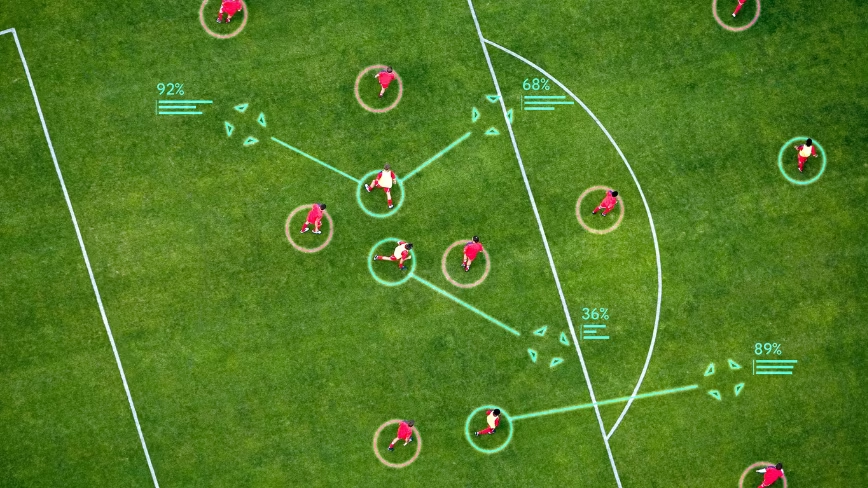
Google DeepMind has unveiled TacticAI, an innovative artificial intelligence solution designed to revolutionize tactical analysis in football. This system is capable of predicting the evolution of game plays with a surprising lead time of up to eight seconds, offering teams an unprecedented strategic advantage. The ability to anticipate opponent moves or offensive opportunities represents a significant qualitative leap in the application of AI to the world of sports.
The first club to benefit from this technology is Palmeiras, one of Brazil's most renowned teams. The club is using TacticAI for real-time analysis of matches, focusing on open-play dynamics. This initial deployment highlights AI's potential not only for post-match analysis but also as a dynamic decision-making tool during live sporting events.
The Technological Core of TacticAI: Geometric Deep Learning
At the heart of TacticAI lies an advanced methodology: geometric deep learning. This branch of deep learning is particularly well-suited for modeling data with an intrinsically geometric structure, such as player movements on a football pitch. The system analyzes visual data from standard broadcast feeds, processing player positions and trajectories to build a dynamic model of the game.
Through the analysis of these complex patterns, TacticAI is able to predict future player and ball trajectories, anticipating the possible evolution of the action. It doesn't stop at prediction: the system is also capable of suggesting tactical adjustments, providing coaches and analysts with concrete tools to optimize strategies in real-time. This requires an extremely efficient data processing pipeline and significant computational power to handle high-resolution video streams and complex models with low latency.
Context, Implications, and Deployment Challenges
The introduction of TacticAI highlights a growing trend in the adoption of AI for predictive analytics in data-intensive sectors. For organizations considering the implementation of similar AI systems, especially those operating with sensitive or proprietary data like sports strategies, crucial considerations regarding data sovereignty and control emerge. Managing real-time video streams and executing deep learning models require robust infrastructures, often based on high-performance GPUs.
The choice between a cloud deployment and a self-hosted or on-premise solution becomes strategic. While the cloud offers scalability and flexibility, an on-premise infrastructure can guarantee greater data control, reduced latency for real-time processing, and, in many scenarios, a more advantageous Total Cost of Ownership (TCO) in the long run, especially for consistent and predictable workloads. The need to process large volumes of visual data in real-time with complex models makes the choice of hardware and deployment architecture a decisive factor for success.
Future Prospects and the Role of On-Premise in Predictive AI
TacticAI's success in predicting football dynamics paves the way for a wide range of predictive AI applications across various sectors, from logistics to finance, manufacturing to security. The ability to anticipate future events, even with a few seconds' notice, can generate immense value, enabling more informed decisions and proactive reactions.
For businesses aiming to leverage these capabilities, evaluating deployment options is fundamental. AI-RADAR focuses precisely on these challenges, offering analytical frameworks for those considering on-premise or hybrid deployments. These approaches allow for balancing performance, security, data sovereignty, and TCO needs, ensuring that the underlying infrastructure aligns with the organization's strategic objectives. The TacticAI experience demonstrates that predictive AI is now a concrete reality, and its widespread adoption will require careful infrastructural planning.







💬 Comments (0)
🔒 Log in or register to comment on articles.
No comments yet. Be the first to comment!