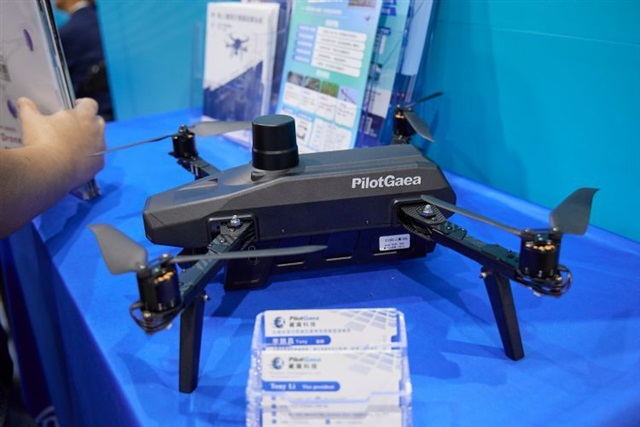
Batteries for cargo or reconnaissance drones don't usually make headlines. Or at least they didn’t until yesterday. Today, the DIGITIMES report that Taiwan has become Ukraine’s third-largest drone battery supplier deserves attention, because it reveals a tightening link between energy hardware and on-board software. In Ukrainian skies, where unmanned vehicles operate in swarms and often with spotty radio links, on-device artificial intelligence stops being an academic exercise: it is the difference between mission success and failure. And that same AI depends on an overlooked component: the battery.
The connection is not trivial. Modern drones integrate computer vision models, tracking algorithms, and sometimes lightweight LLMs for real-time tactical data processing. These workloads demand dedicated processors — embedded GPUs, FPGAs, or ASICs — that drain power. In a conflict where every gram of payload matters, battery energy density imposes hard limits: more flight minutes mean more teraflops delivered on board, more inference cycles without leaning on cloud or ground stations. Taiwan’s supply is thus not just an export line item: it is a direct enabler of autonomous capabilities in the field.
Taiwan is no stranger to this hybrid role. The island dominates advanced semiconductor manufacturing but has cultivated a network of battery and power-electronics component makers that now finds an unprecedented outlet. The Ukrainian conflict accelerates the adoption of drones with high-end AI capabilities, turning a niche into a contested market. For Kyiv, having a third supplier reduces dependence on other nations and strengthens a logistics chain under stress. For Taiwan, it’s strategic diversification. For China, a far-from-neutral signal, given geoeconomic tensions.
The timing of this news also signals structural maturation: edge AI is moving beyond experimentation to become an ecosystem where every component — from silicon to lithium — enters the geopolitical game. Drone battery makers are not just selling electrochemical cells; they are selling operational autonomy, flight hours that translate into distributed computational capacity. It’s the same principle by which a company evaluating on-premise LLM deployment measures its capacity in GPUs and VRAM, or an industrial data center worries about the cost per kWh. Hardware is the invisible prerequisite. When it becomes scarce or vulnerable, AI stalls.
For developers of autonomous drones, the equation is simple: the more complex the embedded models, the more power is needed. Lithium-iron-phosphate (LFP) batteries and emerging solid-state technologies thus become strategic assets. Taiwan’s growing strength in military drone battery components signals an awareness: the AI supply chain isn’t built only from data center servers, but from mobile nodes with high autonomy. And the constraints on those nodes — available power, thermal dissipation, reliability in harsh environments — mirror the same concerns faced by those running inference locally in factories, hospitals, or forward operating bases.
The next time a system integrator or startup considers bringing an LLM on-premise, they’d do well to think about the power socket, too. And perhaps about where batteries are made.




💬 Comments (0)
🔒 Log in or register to comment on articles.
No comments yet. Be the first to comment!