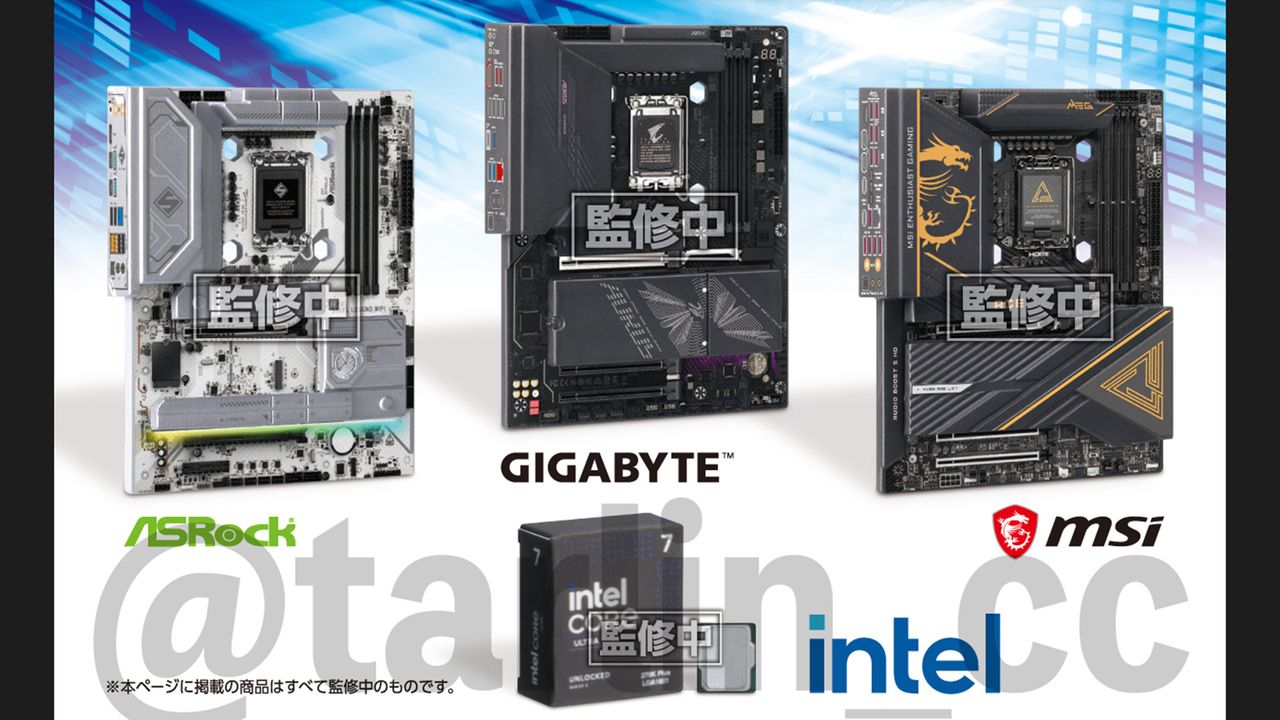
A toy that tastes of silicon. Tarlin, a Japanese company active in niche merchandising, has announced a partnership with the “big four” PC hardware makers to launch a line of hyper-realistic capsule toys. The palm-sized models reproduce motherboards, cases, and CPUs under official license, and can be assembled and disassembled like real components.
The move marks an unusual crossroads between the collectibles world and computer architecture. The capsule toys, sold through the typical Japanese vending machines, promise obsessive detail and a level of fidelity that will delight DIY computing veterans. Precise scale and materials aren’t given, but the news confirms that the four giants – presumably the leading x86 motherboard and component manufacturers – have granted rights to shrink their products into desk miniatures.
More than a gimmick: the persistence of hardware culture
In 2025, as IT infrastructure is dominated by cloud, containers, and abstractions, a toy celebrating physical components reveals an often overlooked fact: the passion for bare metal never died. Those who run on-premise LLM inference workloads know that choosing silicon, fan placement, and motherboard layout are concrete decisions affecting TCO, latency, and data sovereignty.
Tarlin’s capsule toys may seem ephemeral, but they embody the same DIY spirit that drives people to build self-assembled servers for self-hosted models. The pleasure of handling real hardware, of seeing components click together, is an experience that often marks the first step toward a deeper understanding of system architecture. It’s no surprise that in many enthusiast communities, scaled-down replicas are cult objects, displayed alongside GPU‑filled racks.
From wafer to server room: the link to on-premise
The news carries weight beyond the gadget. That the “big four” grant licenses for official miniatures signals a desire to strengthen the emotional bond with their technical user base – the very people who later choose the same brands for their infrastructure. For those evaluating on-premise deployments, loyalty to a hardware ecosystem is also built through such side initiatives.
An IT administrator who today decides to bring LLM inference in-house, avoiding the cloud, seeks control, predictability, and security. Physical components whose every dimension and characteristic they know become building blocks of an architecture under their own control. Tarlin, with its miniatures, pays tribute to that very design culture: each piece, however tiny, is recognizable, faithful, and can be mounted to perfection.
Playing to understand, owning to decide
The arrival of these capsule toys won’t shift the server market, but it reminds us that the relationship between humans and machines still runs through matter. While Large Language Models grow ever more abstract (tokens, pipelines, quantization), the need to touch what makes them tick remains an antidote to the distance imposed by the cloud.
Tarlin’s initiative tells us that hardware, even in pocket format, continues to tell stories of community, expertise, and choice. And in a landscape where AI workloads push toward hyperscaler concentration, every signal of a return to bare metal is a reminder: on-premise has deep roots, sometimes nourished by a toy.






💬 Comments (0)
🔒 Log in or register to comment on articles.
No comments yet. Be the first to comment!