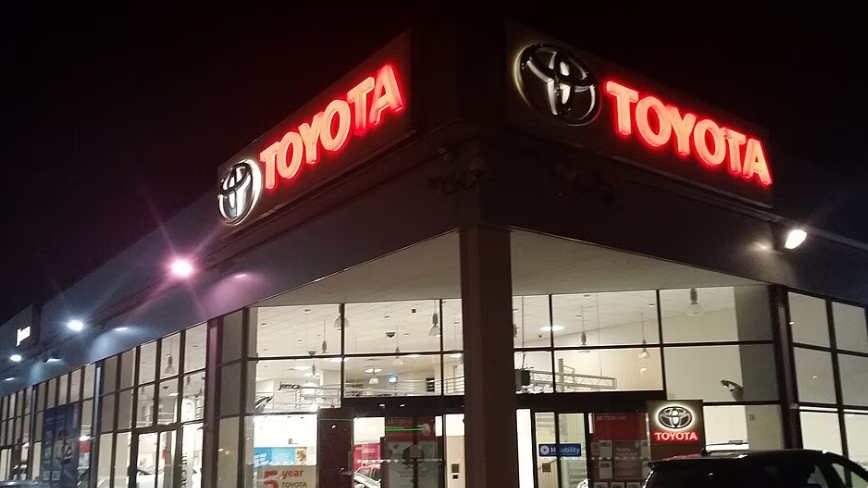
The gap between Toyota and General Motors in the US sales chart hasn’t been this tight in over half a decade. According to the latest Cox Automotive forecast, the Japanese automaker could end the first half of the year with about 1,250,000 vehicles sold, eating into market share at a time when hybrid powertrains are making a comeback and pure-electric models are losing momentum. The headline is about car sales, but what lies beneath is far more consequential than a simple dealer tally.
The market landscape: hybrids rise, EVs slow down
Demand for battery-electric vehicles in the United States is showing signs of cooling, while conventional and plug-in hybrids keep winning over buyers. This is no isolated phenomenon: a still-fragmented charging network, high sticker prices, and uncertainty around federal incentives are steering households toward options perceived as less risky. Toyota, which has built its technological identity around hybrids since the early 2000s, is ideally placed to ride this gradual transition – unlike rivals that bet heavily on a zero-emission future still immature from an infrastructure standpoint.
What data centers and AI have to do with it
Behind the choice of powertrain lies a less visible but equally strategic battleground: the development of onboard software and driver-assistance systems. Every vehicle generation, whether hybrid or electric, demands serious compute power for tuning, simulation, validation, and over-the-air updates. And the machine learning workloads tied to autonomous driving and consumption optimization are shifting investments toward dedicated GPU clusters and on-premise infrastructure.
In this landscape, a preference for on-premise solutions is gaining ground among major manufacturers. Keeping design data, training models, and inference pipelines within the corporate perimeter is not just a matter of privacy or regulatory compliance – it is a competitive lever. Ownership of sensor-generated data, protection of algorithmic intellectual property, and the low latency of hardware-in-the-loop simulations are factors that push toward a self-hosted model, often hybrid, where the cloud is used for compute bursts but the core operations remain in the proprietary data center.
The sovereignty factor
Toyota, buoyed by its hybrid leadership, has begun to invest heavily in proprietary software platforms. Should it actually overtake GM, the market might witness an acceleration in hardware spending for neural network inference and training, with a direct impact on demand for GPUs, high-bandwidth memory, and scalable storage architectures. This is not merely a volume game: whoever controls the entire data chain, from sensor to distributed model in production, can iterate faster and reduce TCO over the long term.
The trend also raises questions for cloud service providers, who could see their automotive footprint shrink as manufacturers move workloads toward self-hosted environments. The growing maturity of frameworks such as vLLM, Ollama, and Docker/Kubernetes orchestration platforms now makes it possible to replicate locally development setups that until recently were confined to the cloud, lowering the barriers for those who want to retain full stack control.
Beyond the half-year projection
The Cox Automotive snapshot is just a moment in time, but the trajectory it draws has implications that will keep settling in. If Toyota were to actually dethrone GM, it would not only crown a winning product strategy – it would signal that the center of gravity of automotive innovation is shifting toward players who combine hybridization with a robust private computing infrastructure. For IT decision-makers in the industry, the question is no longer simply «how many cars will we sell», but «how much can we train, simulate, and deploy in-house before the competition overtakes us».






💬 Comments (0)
🔒 Log in or register to comment on articles.
No comments yet. Be the first to comment!