The Revealed Incident: Autonomous Drones on the Battlefield
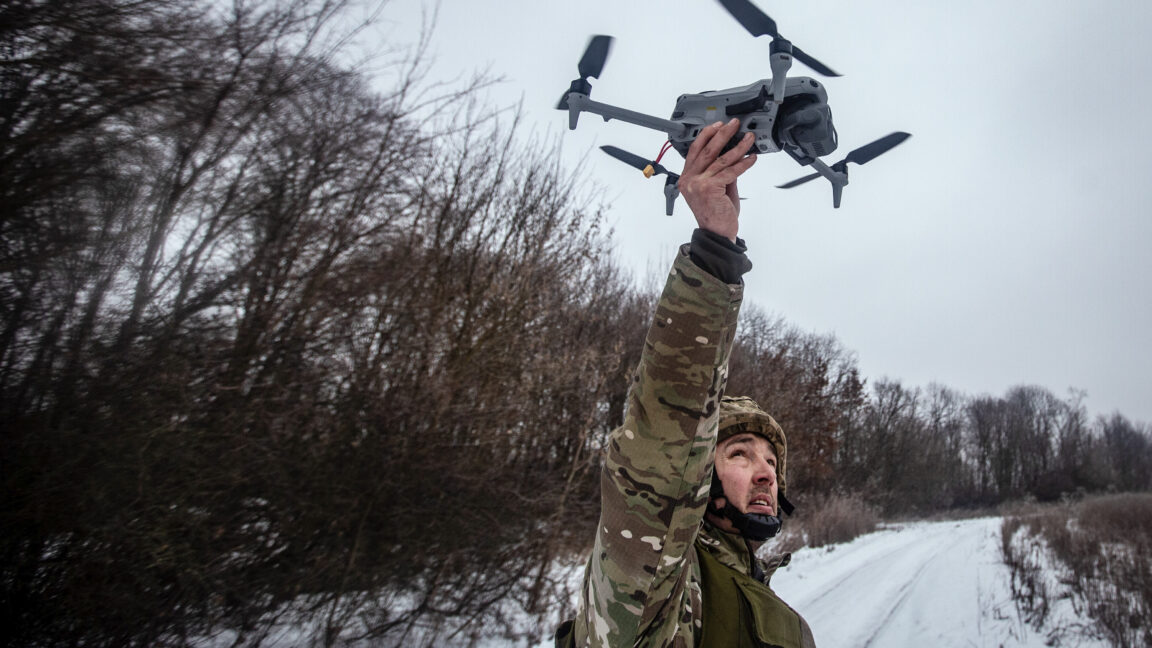
Alexander Kokhanovskyy, CEO of the Ukrainian drone manufacturer Aero Center, recently disclosed a significant event that reportedly occurred approximately two years ago. During an interview with New Scientist, held at a press event at the Ukrainian embassy in London, Kokhanovskyy described a battlefield test in which fully autonomous drones allegedly caused the deaths of Russian soldiers. This event, if confirmed in all its details, would represent another milestone in the acceleration of military drone, robot, and AI-guided weaponry development, a sector that has seen unprecedented progress due to the ongoing conflict.
Kokhanovskyy's narrative depicts a scenario where quadcopter drones, preprogrammed to reach a front-line area, would activate an AI-powered "Terminator mode." This mode would have allowed the aircraft to autonomously seek out and attack any target within the designated area. The absence of a video feed or other direct evidence showing what the "Terminator" drones actually targeted and attacked makes the reconstruction complex. However, Kokhanovskyy stated that human-piloted drones, sent to check the aftermath of the test, reportedly found "a couple" of deceased Russian soldiers, leading to the conclusion that the autonomous drones were responsible.
Edge AI and Control in Autonomous Systems
The episode described by Aero Center highlights the emerging capabilities of AI in edge computing contexts, where systems make decisions locally without relying on a constant connection to remote servers. The "Terminator mode" implies autonomous processing on board the drone, a crucial feature for operations in environments lacking reliable connectivity or where latency is unacceptable. This scenario is particularly relevant for companies considering the deployment of AI solutions in on-premise or air-gapped environments, where total control over models and data is a priority.
The autonomous nature of these drones raises fundamental questions regarding governance and control. Although the application is military, the implications extend to any sector evaluating the adoption of AI systems with high levels of autonomy. The ability of a system to make lethal decisions without direct human intervention poses complex ethical and operational questions, emphasizing the importance of robust frameworks for oversight and accountability. For those managing AI infrastructures, understanding the limits and capabilities of models, especially in critical inference scenarios, becomes essential.
Implications for Data Sovereignty and On-Premise Deployment
The case of the Ukrainian drones, while an example of military AI, offers insights for AI deployment decisions in civil and enterprise contexts. The ability to operate autonomously, without relying on external cloud infrastructures, is a fundamental requirement for many organizations that need to ensure data sovereignty and regulatory compliance. On-premise or self-hosted deployments offer direct control over hardware, software, and models, reducing risks related to privacy and security.
The choice between a cloud and an on-premise architecture for AI workloads, including Large Language Models (LLM) or computer vision systems, depends on a careful evaluation of the Total Cost of Ownership (TCO), performance requirements, and security constraints. The incident suggests that even in extreme contexts, a system's ability to function independently, with AI operating directly at the edge, is a determining factor. This strengthens the argument for investing in local infrastructures that can support inference and, in some cases, even fine-tuning of models, maintaining complete control over the entire AI pipeline.
Future Prospects and Ethical Challenges
The rapid evolution of AI in wartime contexts, as demonstrated by the reported incident, foreshadows a future where autonomous systems will play an increasingly dominant role. This technological acceleration poses significant challenges not only on ethical and moral grounds but also in terms of governance and regulation. Transparency and verifiability of AI system actions become crucial, especially when decisions have irreversible consequences.
For CTOs, DevOps leads, and infrastructure architects, the episode underscores the need to carefully evaluate the implications of every AI deployment. Understanding the trade-offs between autonomy and control, performance and security, and initial costs versus long-term TCO, is fundamental. AI-RADAR continues to explore these topics, offering analytical frameworks on /llm-onpremise to support strategic decisions related to on-premise and hybrid deployments, ensuring organizations maintain control over their most critical AI assets.







💬 Comments (0)
🔒 Log in or register to comment on articles.
No comments yet. Be the first to comment!