
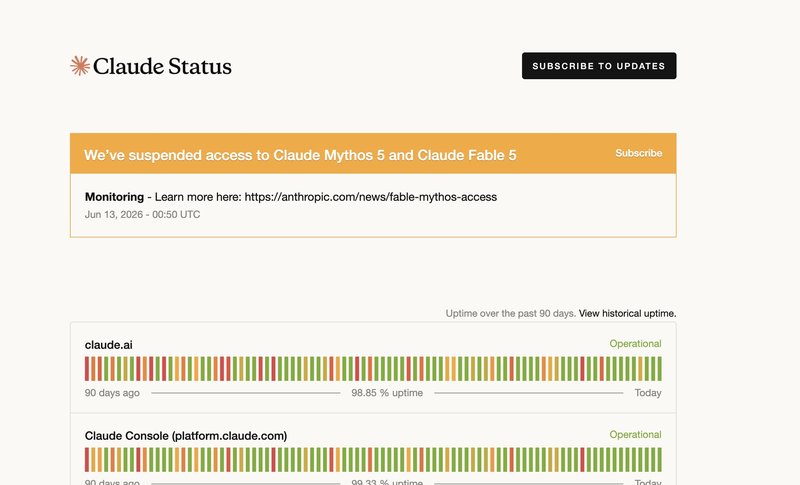
After roughly three weeks of freeze, the US Commerce Department has lifted the export controls that kept Anthropic’s Fable 5 offline, the company’s most advanced model. The news, broken by Reuters on Tuesday, June 30, was officially confirmed by Anthropic within hours, ending a blackout that had raised more than a few questions about the availability of cutting-edge LLMs outside the United States.
A long-awaited decision, but a telling one
Fable 5 — part of the Claude family — had been pulled from digital circulation following the imposition of export restrictions, a tool Washington uses to limit access to technologies deemed sensitive. While the revocation came relatively quickly, the episode served as a sharp reminder that access to frontier models can be severed by a regulatory stroke, even for organizations with established cloud contracts. Anthropic did not disclose the original rationale behind the measure, but the mere fact that a flagship LLM can be “turned off” by decree forces a strategic rethink.
Export controls: beyond hardware
When discussing export controls in AI, the focus often falls on GPUs, accelerators, and compute nodes. Bringing software in the form of pre-trained models into this perimeter broadens the picture: it is no longer only about chips, but also about intangible assets that determine inference and fine-tuning capabilities. The Fable 5 case shows that the boundary has become porous, pulling in deployment pipelines that until yesterday were considered purely cloud-based and immune to geopolitical dynamics.
Implications for data sovereignty
The swing between availability and restriction of a model like Fable 5 has concrete consequences for organizations evaluating on-premise or hybrid architectures. In regulated sectors — finance, healthcare, defense — dependence on a single cloud provider for LLM access creates vulnerabilities that go beyond cost: operational continuity and compliance are at stake. For those evaluating on-premise deployment, AI-RADAR offers analytical frameworks at /llm-onpremise to weigh the trade-offs between direct control and third-party dependence, especially when frontier models can become inaccessible overnight.
The halo effect: renewed focus on local stacks
The brief disappearance of Fable 5 may accelerate interest in self-hosted solutions, where models — even if less performant than the latest generation — remain permanently accessible and auditable. It is no coincidence that investments in quantization, local serving frameworks, and fine-tuning pipelines on consumer hardware have grown in the past year. Technological sovereignty hinges on the ability not to be caught off guard when a cloud model vanishes, and this week’s lesson reinforces the need for hybrid architectures and continuity plans that include on-premise options.
A structural fragility not to be underestimated
The swift lifting of controls on Fable 5 does not erase the underlying message: the distribution system for frontier LLMs rests on fragile regulatory equilibria. For those deploying in production, ignoring this variable means accepting an incalculable risk. The episode puts data sovereignty, AI supply chain transparency, and the need for resilient architectures back at center stage — where self-hosted deployments are not a luxury but a cornerstone of operational independence.








💬 Comments (0)
🔒 Log in or register to comment on articles.
No comments yet. Be the first to comment!