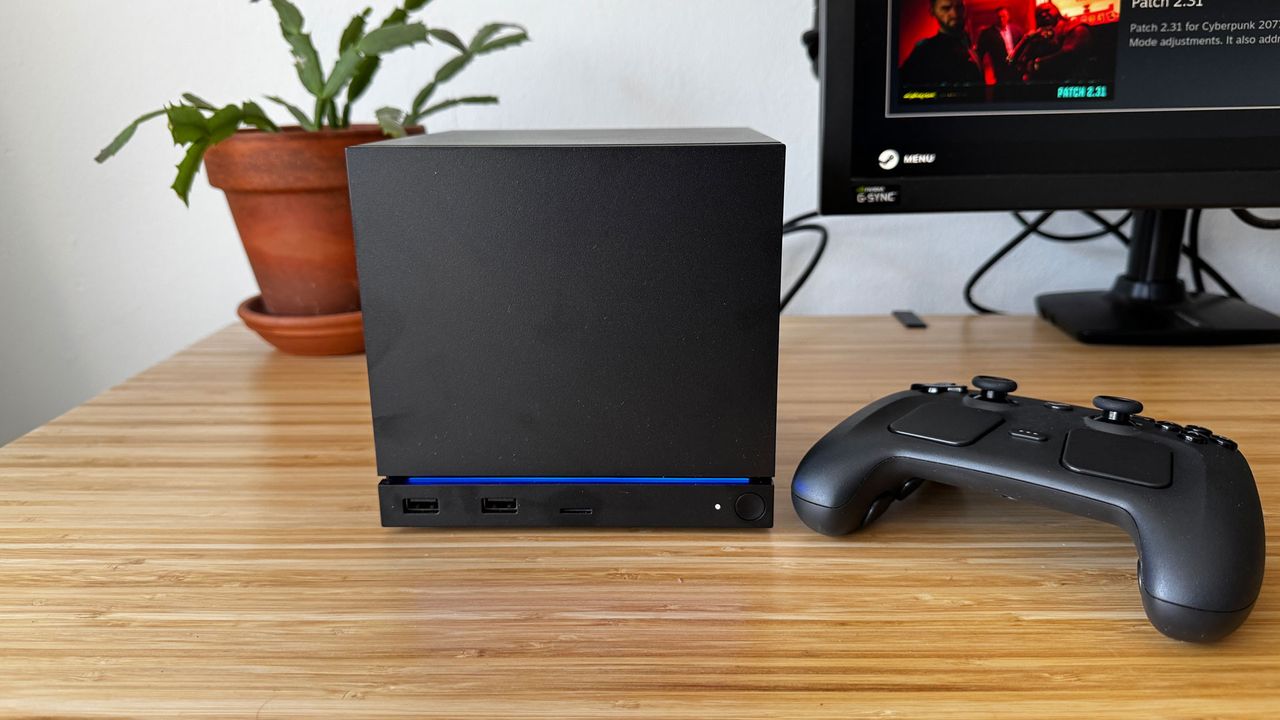
Valve is quietly preparing SteamOS for the mass market, and although details remain sparse, the implications are substantial. The company behind the Steam Deck has announced a collaboration with Nvidia to smooth out driver compatibility, and hints at future dual-boot capabilities — two signals that point to a Linux-based OS ready to step beyond its handheld origins.
Turning a handheld OS into a universal platform
SteamOS, in its current form, is an Arch Linux derivative tightly integrated with Proton, the compatibility layer developed with CodeWeavers that makes running Windows games a near-transparent affair. Optimized for the Steam Deck’s fixed hardware, it impressed with fluidity, power management, and a streamlined interface. But the new initiative aims to untether the OS from a single device: Valve is working on a version that can be installed on generic PCs, and it is directly engaging Nvidia to ensure the experience matches what users expect from a plug-and-play environment.
Historically, Nvidia GPUs on Linux have been a point of friction — proprietary drivers, open-source alternatives, and inconsistent desktop integration created hurdles that discouraged casual users. A close cooperation with Nvidia could change that, making SteamOS as straightforward on an RTX-powered desktop as it is on the Deck.
The dual-boot piece of the puzzle
The mention of dual-boot, however tentative, is significant. It suggests Valve wants SteamOS to coexist with other operating systems without forcing users into repartitioning nightmares. A notebook could boot into a gaming-optimized environment while preserving a separate partition for productivity, giving a clean on-off switch between use cases.
This transparency extends beyond entertainment. For anyone running workloads on local hardware — LLM inference, simulation, or data analytics — the ability to reserve a partition for a tuned Linux OS with first-class Nvidia drivers lowers the deployment threshold. AI-RADAR, focused on on-premise stacks for AI, notes that driver headaches and OS configuration often push organizations toward cloud solutions, even when data sovereignty or TCO considerations would favor self-hosting. A distribution that solves these issues at the OS level makes local GPU compute more accessible to teams without dedicated Linux administration skills.
Why Nvidia compatibility matters more than frame rates
The Nvidia collaboration isn’t just about gaming frame rates; it’s about unlocking the full compute potential of modern GPUs. The same hardware that renders ray-traced scenes can accelerate matrix multiplications for quantized language models, and a stable OS stack with solid driver support is the first prerequisite. If SteamOS delivers on that promise, it becomes a candidate for lightweight compute nodes, especially in environments where simplicity and repeatability are valued.
Linux users have long waited for a better relationship between the open-source ecosystem and Nvidia’s hardware. Today, getting CUDA, kernel modules, and libraries to sing in harmony often requires hours of tweaking. A distribution that ships with these components pre-tested and maintained by a major industry player changes the calculus, even if Valve never mentions AI in its marketing.
A signal for local infrastructure
AI-RADAR views this move less as a gaming announcement and more as an infrastructure signal. A major tech company is investing in a general-purpose Linux OS, betting on Nvidia compatibility, and designing for dual-boot — all decisions that lower the bar for on-premise GPU utilization without leaning on cloud resources. For organizations bound by data residency rules or calculating long-term TCO, a free, GPU-optimized OS could complement or replace existing desktop Linux distributions in certain scenarios.
Of course, the road ahead is steep. SteamOS must prove itself across a wilderness of hardware configurations and win over an audience accustomed to the familiar rhythms of Windows. Yet Valve’s track record with Proton — turning a compatibility layer into a near-native experience — suggests this is more than an experiment. It is a living demonstration that a Linux-based OS can be practical enough for users who never want to open a terminal, and powerful enough for those who need every last teraflop on their local machine.






💬 Comments (0)
🔒 Log in or register to comment on articles.
No comments yet. Be the first to comment!