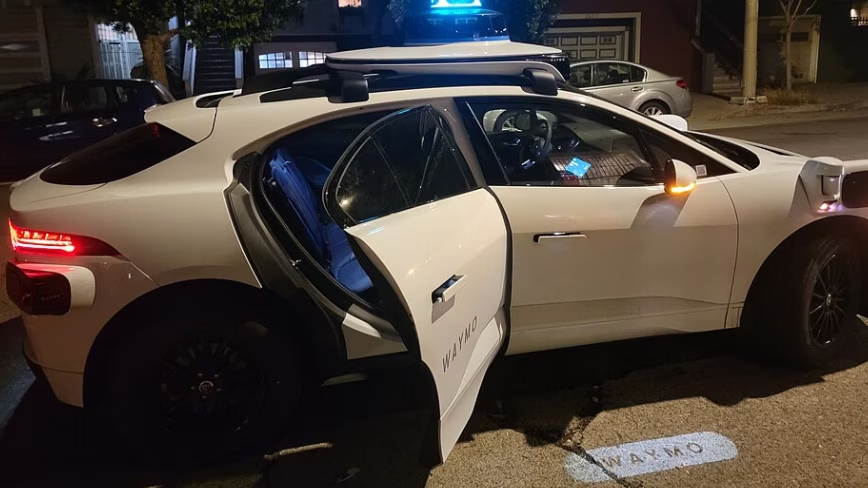
The news came without fanfare: Waymo robotaxis are no longer bookable through the Uber app in Phoenix. After nearly three years, a collaboration that began under the spotlight for its symbolic weight — two former courtroom rivals trying to become road allies — comes to an end. Waymo confirmed to TechCrunch that the vehicles have already been folded back into its own fleet, while Uber has yet to announce how it will fill the gap.
From legal war to desert proving ground
It was 2017 when Waymo, then part of Alphabet, dragged Uber into court over alleged theft of trade secrets related to autonomous driving lidar technology. The case settled in 2018, but left deep scars. The Phoenix partnership, launched in 2022, was an attempt to turn the page: Uber provided its platform and ride demand, Waymo the self-driving vehicles. A test to see whether two different business models could coexist.
A quiet split
No fanfare: both companies simply stopped operating together in the Arizona city. Waymo’s vehicles will continue to serve the Phoenix metro area via the Waymo One app, while Uber must again rely on human drivers and, perhaps, other tech partners. The deal’s end suggests the commercial collaboration didn’t deliver the hoped-for value — or that strategies have diverged further.
The autonomous driving market narrows
The breakup comes at a time of consolidation. After years of promises, the robotaxi sector is selecting a few players: Cruise suspended operations after an incident, Tesla promises but doesn’t deliver, and only Waymo and a few Chinese companies operate at commercial scale. Phoenix was the perfect lab: wide roads, predictable weather, supportive regulation. But integration with traditional ride-hailing platforms hasn’t convinced, perhaps because the added value of an intermediary is limited when the technology owner can manage the user relationship directly.
Technology control: a lesson for on-premise AI
For those watching applied artificial intelligence, the story is instructive. Waymo chose to bring its assets back under its operational umbrella, abandoning an external distribution channel. It’s the same dilemma many enterprises face with Large Language Models: rely on cloud services — convenient, but with data and control surrender — or invest in self-hosted solutions, where technological sovereignty comes at a cost but avoids strategic dependencies. In the robotaxi case, onboard infrastructure processes vast amounts of data in real time, akin to an edge architecture: every decision made locally (inference) must be fast and secure, without sending everything to the cloud. A principle that also applies to on-premise LLMs, where latency and data privacy are critical factors. The Waymo-Uber split isn’t just a news item; it’s a signal: when technology becomes differentiating, direct control is often the only viable path.




💬 Comments (0)
🔒 Log in or register to comment on articles.
No comments yet. Be the first to comment!