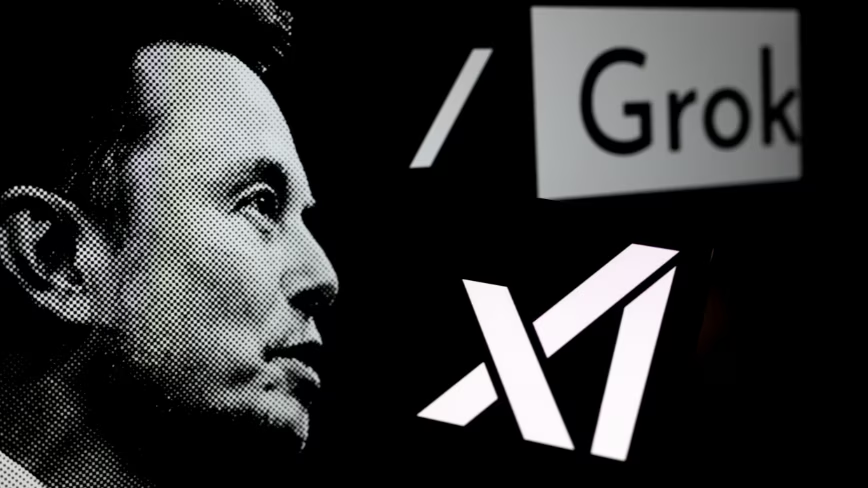
When Ervin Laws steps outside his home in the Colonial Hills neighborhood, the sound is that of an airport with no landing schedule. The turbines run 24/7, a mechanical drone that cuts through walls and eliminates any chance of quiet. They are not jet engines: they are gas generators. Fifty-nine of them, to be precise. They belong to xAI, Elon Musk’s artificial intelligence company, and they are fueling the obsession with computational power just a few miles from the Tennessee border.
The number is twice what xAI has so far admitted. Internal emails between the company’s consultants and local authorities, obtained by The Next Web, reveal a reality at odds with official claims. Most of the turbines are concentrated in Southaven, Mississippi – an area where, within a five-mile radius on the Tennessee side, about 94% of residents are Black. That detail shifts the matter from a technical-administrative issue to one of environmental justice.
The lack of permits is not bureaucratic forgetfulness. Dropping nearly sixty gas turbines into a residential zone without going through assessment procedures means bypassing noise and air emission standards and dumping the external costs of an unprecedented technology race onto the local population. This points to a paradox well known to those who work on AI infrastructure: the more strategic compute power becomes, the more energy turns into the weakest link in the chain.
The insatiable energy hunger of language models – from training on GPU clusters to real-time delivery – is pushing companies to seek their own generation sources. The self-hosted approach, which many equate with sovereignty and control, risks becoming an excuse for operational deregulation. Installing turbines without permits is not just a local problem: it is a structural signal that the pressure to bring compute capacity online is producing short circuits between technical ambition and social responsibility.
Here lies a theme that touches anyone evaluating an on-premise or edge deployment: true autonomy also depends on energy sourcing and the management of externalities. During the design phase, Total Cost of Ownership does not end with the sum of CapEx plus OpEx; it includes reputational cost, regulatory risk, and the strength of the social contract with the surrounding community. Ignoring that means exposing oneself to sudden shutdowns, investigations, protests. And, not least, to a stain that is hard to erase in the sustainability reports that more and more customers and partners demand.
The episode raises uncomfortable questions about the relationship between innovation and democracy. The concentration of data centers in areas with weaker environmental protections and less political power is not a geographical accident but a well-established pattern. What is happening in Southaven is the contemporary version of an old story: technology moves forward, and someone is left behind with the roar of engines in their ears.





💬 Comments (0)
🔒 Log in or register to comment on articles.
No comments yet. Be the first to comment!