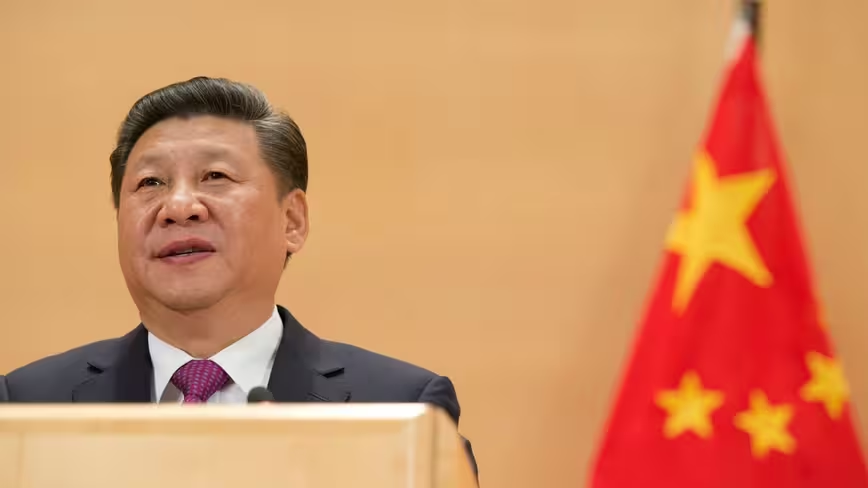
When a head of state walks onto a tech conference stage for the first time, it redraws the boundaries of the conversation. Xi Jinping’s decision to keynote the 2026 World Artificial Intelligence Conference in Shanghai is not a ceremonial note — it’s the most explicit piece yet of a plan that is reshaping hardware, data centers, and LLM ownership inside China.
The timing, just as Beijing tightens restrictions on foreign AI, signals a hard priority: China wants its large language models running on domestically designed, domestically controlled silicon, within tightly defined physical and legal borders. This is not a preference, it’s a sovereignty imperative. For analysts tracking enterprise deployment patterns at AI-RADAR, the move carries cascading implications across the supply chain.
The domestic silicon pivot
For years, US export controls have tightened access to GPUs and accelerators. China’s response has been engineering-led, not just diplomatic. Companies like Huawei with its Ascend chips, Biren Technology, and others are filling the gap with alternative silicon, often optimized for LLM inference and fine-tuning workloads. Xi’s presence gives political cover to this transition: every ministry, state-owned enterprise, or municipality that now evaluates on-premise deployment gets the message that betting on domestic hardware is not a risk, it’s an act of alignment.
That shift changes how data centers are assessed. Decisions are no longer solely based on VRAM, token-per-second throughput, or TCO — they now factor in supply-chain security and the ability to self-host without foreign dependencies. The Shanghai conference becomes a catalyst. China’s ecosystem needs homegrown vertical scaling, and this political signal reduces the uncertainty that tends to freeze medium-term investments.
On-premise as doctrine
There’s a second layer, less visible but more structural. When a government pushes for models trained and served on hardware controlled by state entities or national consortia, the line between cloud and on-premise blurs in favor of the latter. For Chinese enterprises, LLM adoption will increasingly route through internal physical nodes — not just to comply with data-residency laws but to ensure auditability and alignment with central guidelines.
For observers in the West, the parallel is immediate: digital sovereignty is not a Chinese exception but a global trend reshaping deployment architectures. In Europe, GDPR and the AI Act debate push in a similar direction, albeit through legal rather than industrial tools. The difference is that China is building a domestic market where LLM software and chip hardware advance together by design.
What it means for the rest of the world
Xi’s move is not isolated. It fits into a context where the ability to train and serve models without relying on external ecosystems becomes a geopolitical asset. For anyone evaluating on-premise LLM deployments, the Chinese case is an extreme example of how external restrictions can accelerate indigenous hardware innovation. It’s not a prediction — it’s underway: internal demand for alternatives to NVIDIA GPUs is funding a generation of chips that, even if not competitive on raw benchmarks, are fully functional for large-scale inference and fine-tuning.
The 2026 World AI Conference is not a trade show. It’s the moment China declares its AI future will not be leased from third parties but built, layer by layer, on its own foundations.







💬 Comments (0)
🔒 Log in or register to comment on articles.
No comments yet. Be the first to comment!