The DOT Announcement
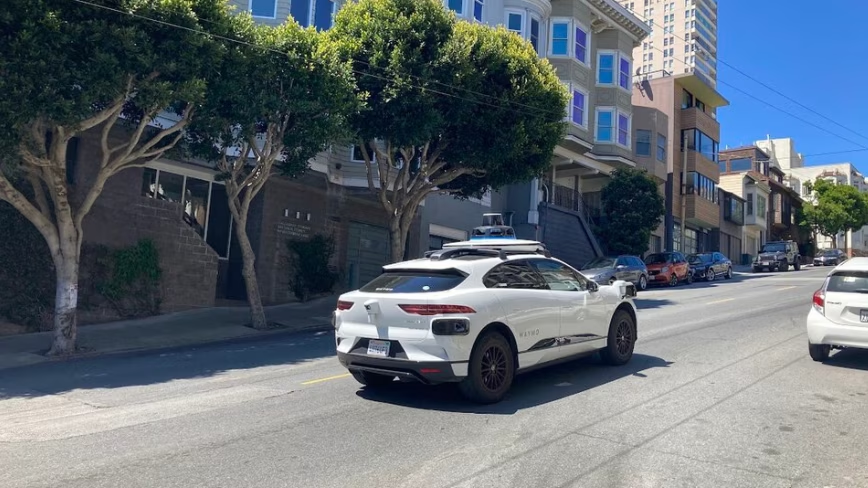
On Wednesday, the Trump administration's Department of Transportation proposed eliminating the federal requirement for brake pedals in vehicles designed exclusively for automated driving systems. The rule change would update Federal Motor Vehicle Safety Standards that still mandate traditional controls—steering wheels, pedals, gear shifters—even on cars meant to operate without a human driver.
The proposal arrives as autonomous taxi and delivery fleets face regulatory logjams: purpose-built vehicles from Cruise, Waymo, and Zoox have invested billions in driverless cabins, but are forced to comply with rules written when full automation was science fiction. Removing the brake pedal—and, by extension, all manual controls—would give the definitive green light to a new generation of vehicles.
What Changes for Autonomous Vehicle Design
The heart of the proposal is as much cultural as technical: until now, a vehicle had to guarantee direct human intervention in an emergency. The brake pedal symbolized that umbilical cord. Removing it means accepting that, under certain conditions, the machine decides and acts without a person being able to correct the trajectory in real time.
For designers, the payoff is immediate. Without the bulk of pedals and a steering wheel, the cabin opens up, gaining space for passengers or cargo, lowering production costs, simplifying sensor integration, and allowing the software stack to be optimized for a single operational mode. But the real stake is federal homologation, without which no manufacturer can register and sell these vehicles in the United States.
On-Prem AI: Lessons from the Missing Brake Pedal
At first glance, the news concerns only the automotive sector. Yet for those working with self-hosted artificial intelligence—from enterprise servers to edge computing nodes—the farewell to the brake pedal is a powerful operational metaphor.
On-prem AI systems, especially those built on LLMs, are following a similar trajectory: from constant human supervision (“human-in-the-loop”) to increasingly autonomous operation, where the model makes decisions independently, answering customer inquiries or orchestrating data pipelines. As with autonomous vehicles, removing the “pedal”—the manual control interface—demands an architectural overhaul. It requires a governance framework that includes audit trails, inference logging, automatic circuit breakers, and, above all, the ability to reproduce and explain the model’s choices. In a self-hosted deployment where data never leaves the enterprise perimeter, that responsibility cannot be offloaded to a cloud provider.
It is no coincidence that the regulatory evolution of autonomous vehicles is being watched closely by digital transformation leaders in industry. The questions are identical: how do you certify a system that operates without human intervention? Who bears liability when something goes wrong? What safety mechanisms must be designed on board—in software and silicon—to ensure that the missing pedal does not become a leap into the dark?
Control and Liability: An Open Perspective
The DOT proposal is only a first step: it must weather public comment, possible amendments, and almost certain opposition. But the direction is clear: the American regulator is betting that the technology is mature enough to do away with the symbols of human control. For the on-prem AI industry, it signals that the market is moving toward operational models where local inference and data sovereignty coexist with levels of automation unthinkable just a few years ago.
Those developing self-hosted solutions today must view this evolution not as a threat but as a design mandate to get ahead. Removing the pedal—in the vehicle as in the data center—is not an act of recklessness but the consequence of a new balance between trust in the machine and stewardship of the processes. A balance that, without manual buffers, demands deeper skills, more transparent stacks, and a security culture baked in from the design stage.
For organizations evaluating on-premise deployment, trade-offs exist: greater data control but also greater engineering burden. AI-RADAR will continue to explore these intersections of autonomy, regulation, and infrastructure, offering analytical frameworks for informed decisions.







💬 Comments (0)
🔒 Log in or register to comment on articles.
No comments yet. Be the first to comment!