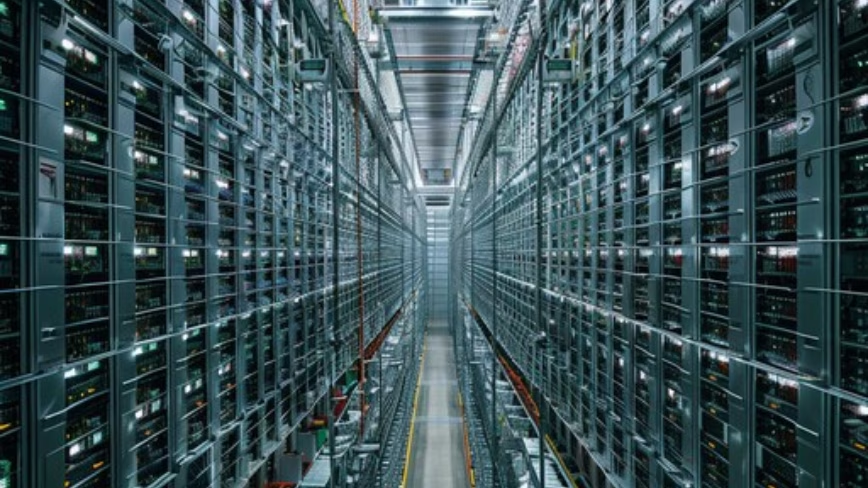
The AI fever has turned data centers into the battlefield of a new infrastructure race. Never before has so much been built so fast: concentrated compute power, doubled digital capacity, delivery timelines squeezed to the limit. But behind the headlines of megawatts and square footage, ER Steel – a company closely tracking the AI construction supply chain – points to a conversation gaining weight: building and powering these facilities responsibly, maintaining efficiency and sustainability over the long run.
The new geography of data centers in the AI era
Global expansion is uneven. Hyperscalers target regional hubs connected by fiber backbones, but the demand for low latency and data sovereignty pushes many organizations to consider on-premise or edge installations. Here, the choice of location intertwines with that of materials: a repurposed industrial shed does not offer the same guarantees as a building designed for AI workloads. Land cost is a variable, but the real match is played on the ability to deliver electrical power and dissipate heat reliably.
Design requirements: when steel meets tokens
Large Language Models (LLMs) impose power densities that were unimaginable five years ago outside supercomputing. Racks of 30–50 kW require direct liquid cooling, specific fire-resistant design, and steel structures with profiles engineered to bear weight and vibration. ER Steel observes that material choices affect passive thermal dissipation – a detail that, across hundreds of racks, can reduce operational expenditure (OpEx) significantly. This is not just civil engineering: it is part of the inference pipeline.
Implications for on-premise deployment and the cost of control
For enterprises evaluating on-premise fine-tuning or inference, these construction elements become integral to TCO. A self-hosted cluster makes sense if the total cost, including physical infrastructure, stays competitive with the cloud and if data control justifies the investment. But designing an undersized environment or one with unsuitable materials means exposing LLMs to thermal throttling, cutting token-per-second throughput and lengthening training times. Under GDPR, the responsibility for physical security falls entirely on the organization.
Designing to last: responsibility as competitive advantage
ER Steel’s message is a call for long-term vision: speed to deployment cannot devour the quality criteria that determine an asset’s useful life. In an industry where density doubles every two years, building only for today means finding yourself with an obsolete asset before you have even amortized it. Modularity, the choice of high-strength steels, and readiness for future cooling upgrades are choices that pay off over time. AI-RADAR, in its /llm-onpremise section, offers analytical frameworks to weigh these variables without oversimplification. Because artificial intelligence, to grow sustainably, needs foundations that won’t buckle under the weight of tokens.







💬 Comments (0)
🔒 Log in or register to comment on articles.
No comments yet. Be the first to comment!