Reactors already running, not a futuristic promise
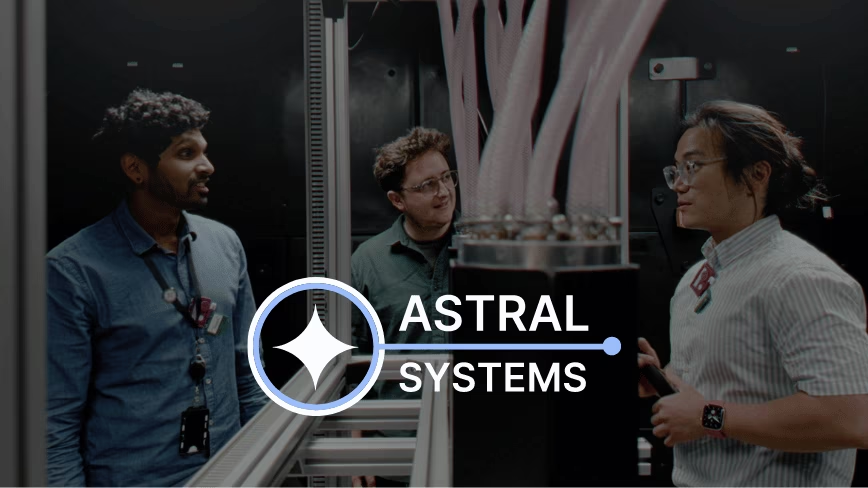
Astral Systems is not yet another startup promising clean fusion energy “in two decades.” The Bristol-based company already operates reactors and has paying customers—a rarity in the fusion landscape, where multi-billion-dollar projects have yet to demonstrate net energy gain. The £23 million round announced today is aimed at scaling the technology commercially, with a very concrete goal: producing medical isotopes where they are needed, without relying on aging research reactors concentrated in a few countries.
What does fusion have to do with cancer scans?
Nuclear medicine relies on radioisotopes like technetium-99m, used in tens of millions of procedures each year to detect tumors, assess cardiac damage, and track metastases. Today, almost all of these isotopes come from a handful of fission reactors in Canada, the Netherlands, Belgium, and South Africa. When one of these facilities shuts down—for maintenance or accidents—the entire global supply chain goes into crisis, forcing hospitals to postpone diagnostic exams. Fusion-based production, on the other hand, can take place in compact devices, potentially installable directly in hospital centers, eliminating transport time and reducing the waste of short-lived radioactive material.
Decentralize to avoid dependency: a lesson for critical data handlers
Astral Systems’ approach closely mirrors the logic driving many organizations to move Large Language Model inference on-premise: gaining direct control over a strategic resource without outsourcing operations to a handful of external providers. Just as a hospital cannot afford to have a reactor halfway around the world block diagnoses for weeks, a company processing sensitive or regulated data cannot depend on cloud APIs subject to latency, unpredictable costs, and compliance risks. Local isotope production brings sovereignty into the physical domain; in the digital realm, the same principle guides those who choose to host AI models on proprietary servers, ensuring data residency and control over fine-tuning.
Total cost and the promise of compact fusion
On the economic front, the goal is clear: reduce the Total Cost of Ownership (TCO) of medical imaging by cutting out middlemen. If a miniaturized fusion reactor can produce isotopes at competitive costs, hospitals could recover their investment within a few years, with the added benefit of an uninterrupted supply. This is not science fiction: Astral Systems states it already has functioning reactors—a milestone missing from almost all competitors—and is generating revenue. The round will serve to industrialize production, making reactors small enough to fit in a hospital wing, with simplified operation.
Outlook: when on-premise becomes a matter of life and death
Fusion for medical use is an emblematic case of how technological decentralization can transform essential services. For those tracking the deployment of critical infrastructure—from AI models to healthcare systems—the Astral Systems story shows that moving production on-premise is not just a convenience choice but a strategic lever for resilience, predictable costs, and independence. As regulators push for greater data sovereignty (think GDPR and its evolutions), the idea of a fusion reactor in a hospital seems no more audacious than a corporate GPU cluster running an LLM far from opaque clouds.







💬 Comments (0)
🔒 Log in or register to comment on articles.
No comments yet. Be the first to comment!