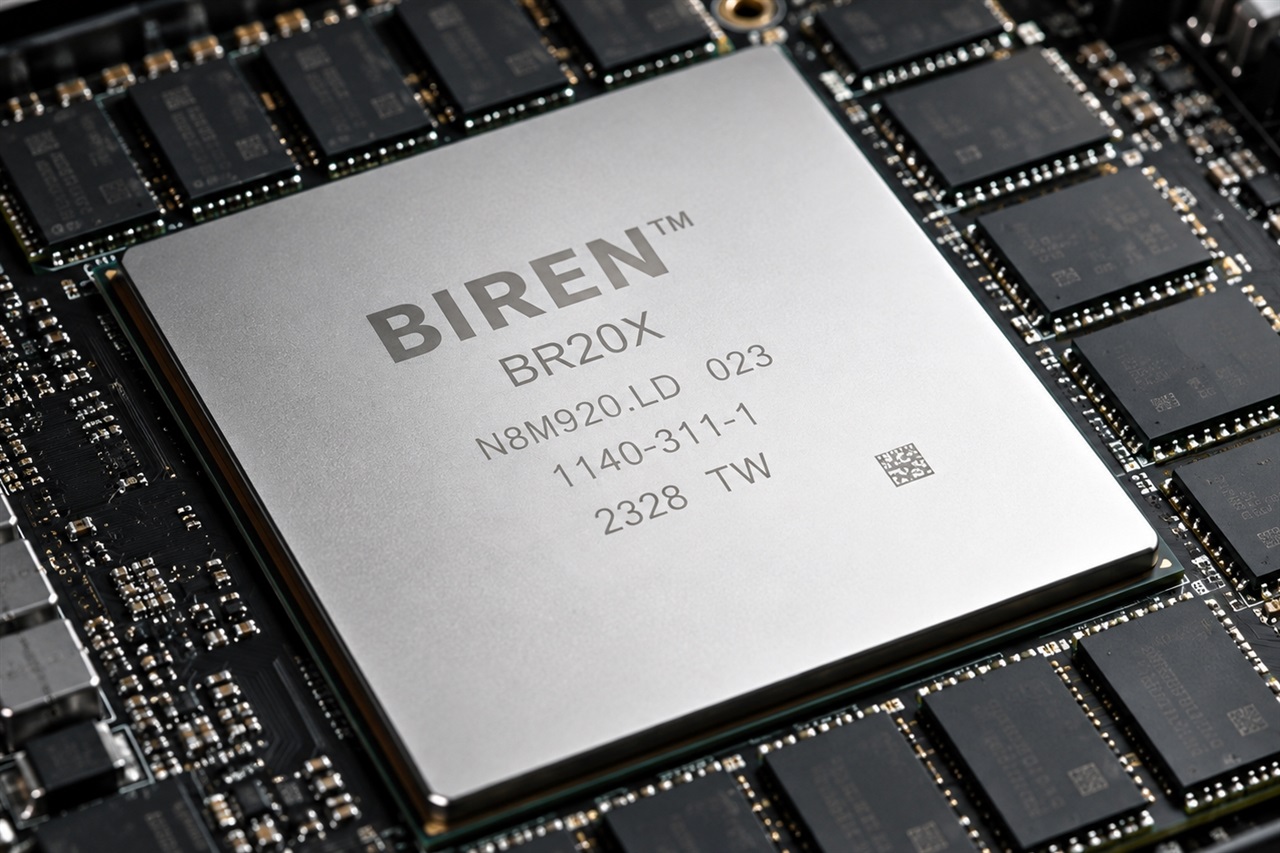
The name BR20X still says little on a technical level, but the strategic signal is clear. Biren, a Chinese AI chip company, is preparing a new GPU designed to compete with Nvidia at a time when the Chinese market is urgently looking for local alternatives. This is not only about performance: the game is about building AI infrastructure on hardware that does not depend on supply chains subject to export controls. The news, reported by DIGITIMES, adds no details on technical specs, pricing, or timing.
For operators in China, the availability of a domestic accelerator changes deployment calculations. Inference workloads, in particular, can be moved to alternative silicon with lower barriers than training, where the software ecosystem and optimized libraries continue to favor Nvidia. Without public data on VRAM, memory bandwidth, and per-token performance, the comparison remains open, and it is unclear whether the BR20X will handle demanding on-premise workloads where energy consumption and thermal dissipation are as critical as peak compute.
The pressure does not come only from Biren. The structural context is a Chinese ecosystem investing on multiple fronts to reduce dependence on US products. This does not erase Nvidia's advantage, which remains strong thanks to the maturity of its software stack and installed base. Still, each new domestic chip expands options for cloud providers, data centers, and companies that must meet data residency requirements. For those required to keep data within national borders, local silicon is not a matter of benchmarks, but of compliance and operational continuity.
There is a less-discussed second-order effect: Chinese competition can accelerate the fragmentation of the AI GPU market. On one hand, local operators benefit from more competitive pricing and a shorter supply chain. On the other, engineering teams must deal with less standardized software stacks and the need to maintain separate pipelines for different hardware. In these scenarios, total cost of ownership is not measured only in dollars per chip, but in integration, maintenance, and model portability. The maturity of CUDA remains a difficult moat to cross: those who choose alternative hardware must invest in compilers, runtimes, and optimizations that often are not yet on par with the established counterpart.
For those evaluating on-premise deployment, the Biren case has value beyond China. It shows how the market is searching for alternatives to the dominant offering, driven not only by economic motives but also by regulatory and sovereignty constraints. The BR20X may not become a turning point; however, it is an indicator that the de facto monopoly on AI GPUs is increasingly contested at the margins, where geopolitical constraints matter as much as benchmarks. The open question is not whether Nvidia will continue to dominate, but how many parallel ecosystems the market will be willing to sustain before one of them reaches critical mass.






💬 Comments (0)
🔒 Log in or register to comment on articles.
No comments yet. Be the first to comment!