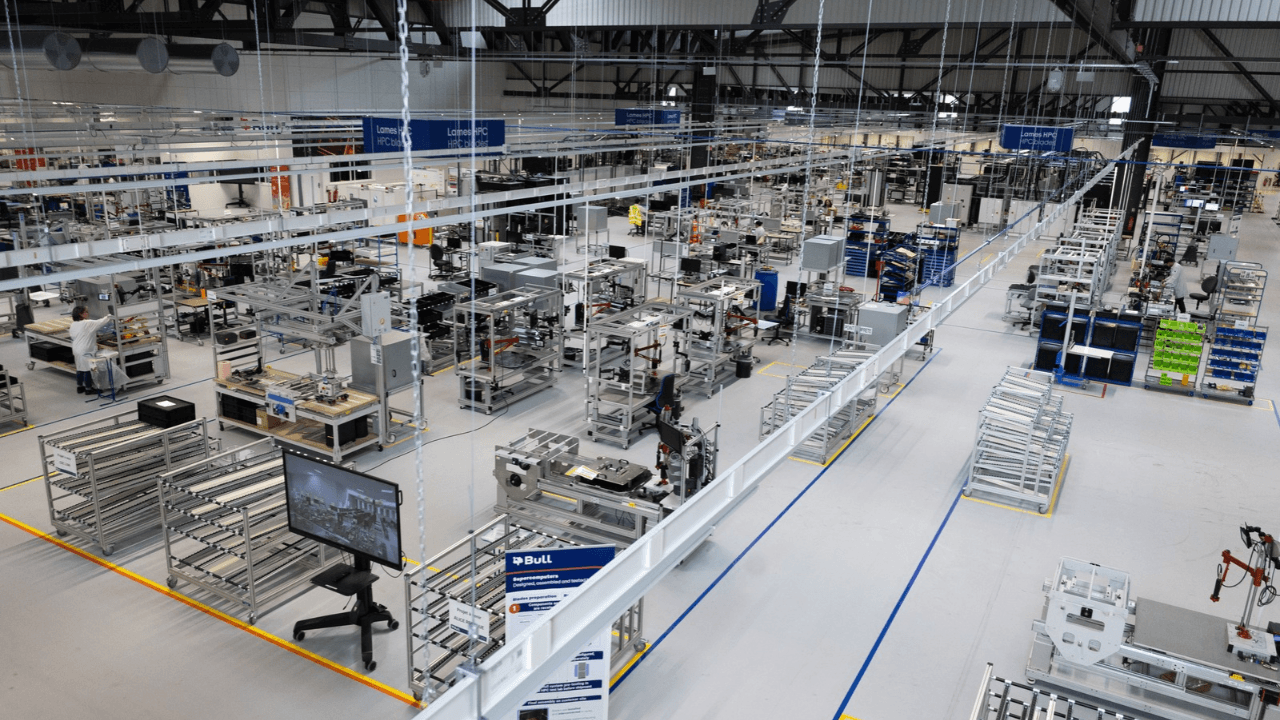
Angers, France. Bull's factory is no longer just a historic site: with an €80 million redevelopment, the French company has turned the plant into a hub where production capacity, supply chain, and engineering meet the startup ecosystem. The new line can assemble 12 racks per week, double the previous rate, with a path to 24. But the most relevant signal is not the quantity: it is the shift in industrial logic.
Nearly 300 people work at the site, with a wider hiring plan expected to bring more. Production is divided into three areas: high-performance computing, AI infrastructure, and testing and validation. It is not a traditional assembly line but a modular environment where technicians work at individual stations with intelligent screwdrivers that adjust torque and reduce errors. Lines can be reconfigured in about ten minutes and relocated in about three days. This flexibility allows Bull to assemble multiple large-scale supercomputers in parallel, previously impossible.
The real bottleneck: the supply chain
The project must be read within Europe's push for technological sovereignty. Bull has developed its BXI interconnect, holds a stake in SiPearl, and now sources electronic boards manufactured in France. According to CEO Emmanuel Le Roux, the share of European components in systems assembled at Angers has risen from 20–30% five years ago to around 70%. The upcoming LUMI-AI supercomputer for Finland will be 70% European-made, compared with 40% for its predecessor and about 5% for competing systems, according to unverified claims.
The story of a US-sourced component costing less than two euros that threatened to halt production explains why technological autonomy is not ideological. Bull's engineers redesigned the circuit board to accommodate an Infineon component and resumed manufacturing. For those evaluating on-premise deployment, the message is clear: resilience does not come from a single supplier but from having real alternatives.
The Open Factory: engineering as currency
Alongside the inauguration, Bull announced the Open Factory, a programme to make its industrial infrastructure and engineering expertise available to other technology businesses. Petr Bednařík, founder of Czech AI company DataSentics and now Bull's AI Strategy Director, says building a factory is out of reach for a hardware or HPC startup. The Angers facility becomes a shared asset, but the value may go further: integrating Bull technology into enterprise projects means access to commercial relationships that are hard to build from scratch. Bednařík is also exploring engineering resources as a form of investment, for example assigning three engineers to a startup for two years as part of the investment. This is not a venture capital fund: for early-stage deeptech, technical expertise can matter more than money.
The factory-access and investment model is still being defined: business planning and board discussions could lead to a structure by the end of 2026 and startup outreach from early 2027. Software startups interested in Bull's platforms can already approach the company.
There is a structural dimension. The EuroHPC programme has committed about €7 billion for 2021–2027 and Bull has won 15 of 18 tenders. European public demand is rewarding those who integrate local production, direct liquid cooling, and data control. Sebastian von Alfthan of CSC notes that an AI factory is not just a data centre full of GPUs: it needs datasets, storage, technical assistance, and regulatory support. For those evaluating on-premise deployment of LLMs, the bottleneck is not hardware alone but the ability to integrate, cool, and manage it reliably. Bull's direct liquid cooling, fanless and using water up to 40°C, reduces energy consumption and makes waste heat recoverable, affecting real TCO.
Bull's move signals that European sovereignty is moving from declarations to physical capacity and skills. The losers include non-European suppliers of standard components, but also startups that expect to scale without industrial ties. The Open Factory offers a path, but it requires integration into an ecosystem with its own standards and constraints. For those evaluating on-premise deployment, the trade-offs between control, cost, and flexibility remain measurable: AI-RADAR offers analytical frameworks at /llm-onpremise to navigate them without shortcuts.




💬 Comments (0)
🔒 Log in or register to comment on articles.
No comments yet. Be the first to comment!