
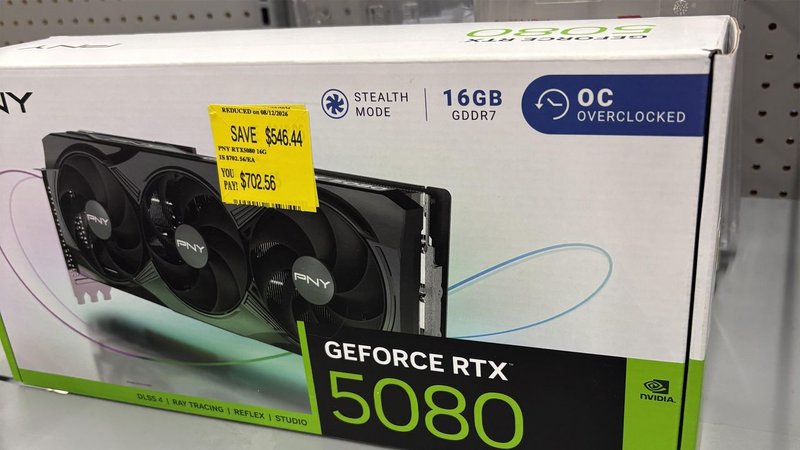
The CDW listing for the PNY NVIDIA RTX Pro 6000 now shows a price of $19,999, up from the $16,000 previously reported for the same card. The change, documented by an archived copy of the product page, did not come with an official announcement: it is simply there, in the cart of a major enterprise reseller. The question circulating among industry watchers is whether this is a legitimate MSRP update or a slip that revealed a pricing revision ahead of schedule.
Beyond the detective work, the datapoint has concrete weight for anyone planning local AI infrastructure. The card carries 96 GB of GDDR7 VRAM: an amount that shifts the boundary of what can run on a single GPU without resorting to multi-accelerator configurations. For large language models, VRAM is the first bottleneck: it determines how large a model can stay in memory, how much room remains for activation cache, and how aggressive quantization must be to make the weights fit. This is not a spec for benchmark enthusiasts: it is the variable that decides whether a self-hosted deployment is economically sensible or whether it makes more sense to fall back on a cloud service.
An increase from $16,000 to $19,999 is roughly 25 percent. For a single workstation node, it may look like a relevant but absorbable CapEx line item. The problem emerges when multiplied across racks dedicated to inference or distributed fine-tuning. In that context, GPU cost is not a list price: it is a lever that shapes TCO, amortization timelines, and the choice between buying on-premises hardware, renting cloud capacity, or staying hybrid. If resellers start moving prices before manufacturers communicate a new MSRP, teams preparing budgets for the next quarters lose a stable reference point.
There is a second layer. Professional cards with large VRAM are in demand not only from rendering teams, but also from groups experimenting with LLMs, from academic labs, and from companies that want to keep data inside their own boundaries. A price that rises without warning makes the path that does not depend on monthly fees and cloud contracts more expensive. This is not a matter of technology preference: it is a matter of investment predictability. Anyone who lived through GPU shortages in past years knows that reseller list prices can anticipate supply chain tension and more aggressive upstream pricing policies.
The concrete fact remains: the CDW page is still online and the archived copy shows the jump. There are no press releases, no denials, no validity date. For now the only verifiable datapoint is the number visible in the listing. Everything else is interpretation, but in a market where VRAM availability conditions the feasibility of on-premises AI projects, even a single price change can become an early signal.






💬 Comments (0)
🔒 Log in or register to comment on articles.
No comments yet. Be the first to comment!