
ChipX's Entry into the AI Data Center Market
ChipX, an emerging player in the technology landscape, has announced its strategy for the artificial intelligence data center market. The company, represented by CEO Chinmoy Baruah at the IndiaAI Summit, aims to provide fundamental hardware components to support the growing demand for AI computing capacity, particularly for Large Language Models (LLMs).
AI's rapid evolution is prompting organizations to rethink their infrastructures. The need to process enormous volumes of data and execute complex training and Inference workloads requires increasingly powerful and efficient hardware solutions. In this context, attention shifts to specialized components that can ensure scalability, reliability, and granular control over operations.
Innovation with Photonics and Power Chips
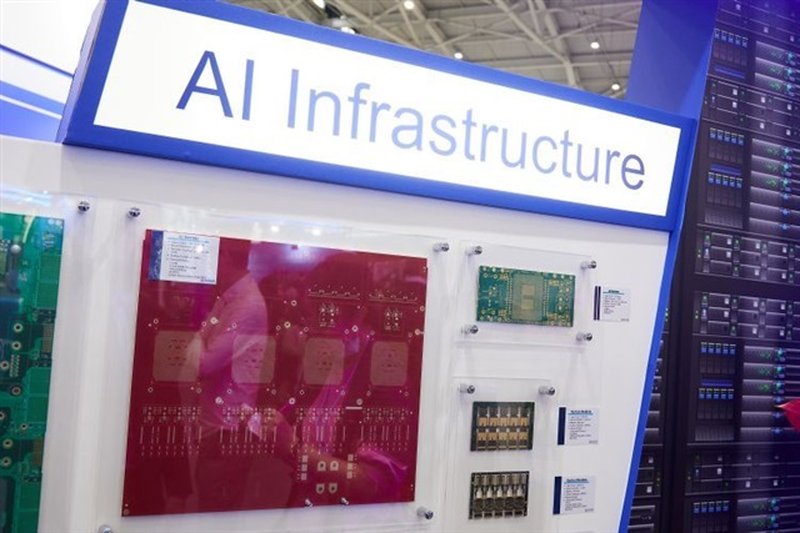
At the core of ChipX's offering are photonics chips and power chips, two critical component categories for the efficiency and performance of modern AI data centers. Photonics chips are essential for high-speed, low-latency interconnects within computing clusters, a crucial requirement for communication between GPUs in distributed environments. These components, based on light rather than electricity for data transfer, promise significant throughput improvements and reduced energy consumption compared to traditional solutions.
Concurrently, power chips play a vital role in energy management, optimizing distribution and reducing power losses within servers and racks. With the increasing compute density and power consumption of next-generation GPUs, efficient power management is not just a matter of operational costs (OpEx) but also of the sustainability and reliability of the entire infrastructure. For companies considering self-hosted deployments, energy efficiency directly translates into a more favorable TCO and greater operational resilience.
Expansion Strategy and the Malaysia Fab
ChipX's commitment to the AI hardware sector is further reinforced by plans for the construction of a manufacturing facility in Malaysia. This strategic move underscores the company's desire to expand its production capabilities and solidify its position in the global semiconductor supply chain. The availability of dedicated manufacturing capacity is a key factor in meeting the growing demand for specialized AI chips.
Manufacturing localization can also have significant implications for supply chain resilience and technological sovereignty. In an era of increasing geopolitical complexity, having diversified and regional production options can offer greater stability and control over the supply of critical components, an aspect increasingly considered by decision-makers managing large-scale infrastructures.
Implications for On-Premise AI Infrastructure
For CTOs, DevOps leads, and infrastructure architects, the emergence of providers like ChipX with specialized hardware solutions is highly relevant. The choice of advanced photonics and power components can directly influence the performance, energy efficiency, and overall TCO of on-premise AI deployments. The ability to build self-hosted infrastructures with complete control over data and hardware remains a priority for many organizations, especially in sectors with stringent compliance and data sovereignty requirements.
Evaluating these solutions requires a thorough analysis of the trade-offs between initial investment (CapEx) and long-term operational costs, as well as technical specifications such as GPU VRAM, interconnect throughput, and latency. For those evaluating on-premise deployments for LLM workloads, AI-RADAR offers analytical frameworks on /llm-onpremise to compare and assess different options and their constraints, supporting informed decisions without direct recommendations.






💬 Comments (0)
🔒 Log in or register to comment on articles.
No comments yet. Be the first to comment!