
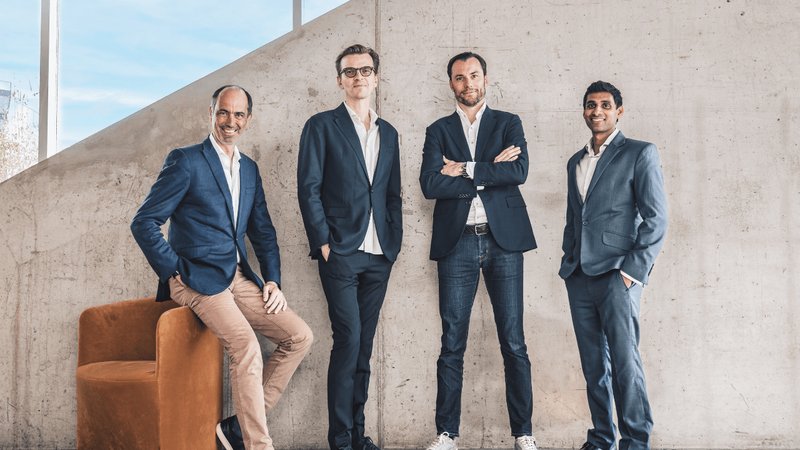
Raising €60 million at a time when fundraising for frontier hardware is no joke. Climentum Capital, a Copenhagen-based fund, has announced the first close of its second climate tech vehicle. The subscribers are institutions that don’t follow momentum: the European Investment Fund (EIF), Denmark’s export and investment fund EIFO, and the Danish Society of Engineers (IDA), a trade union representing over 180,000 engineers and IT professionals.
The goal is to invest in European startups building hardware and deep tech solutions for energy, industry, transport and agriculture, with a geographical focus on Denmark, Sweden, Germany, Austria and Switzerland. The first fund, launched in 2022, had already closed at €60 million; Fund II targets up to €100 million, with the initial close matching its predecessor’s size in a far more selective environment.
General Partner Morten Halborg doesn’t mince words: “The fundraising environment for early-stage climate hard tech has not been easy in recent years. Investors are more selective, timelines are longer, and the proof bar is higher. That is why the composition of the Fund II launch matters: our investor syndicate reflects informed conviction, not momentum investing.”
This isn’t a story that touches only renewables or industrial efficiency. For anyone building or managing on-premise compute infrastructure—especially workloads tied to Large Language Models—energy availability and its footprint are already a TCO variable that’s hard to ignore. Modern data centers, even smaller ones set up in-house for inference on quantized models, draw significant continuous power. And the trend toward multiplying compute nodes, driven by distributed fine-tuning or always-on self-hosted services, amplifies the problem.
The climate hardware backed by Climentum doesn’t produce GPUs or network cards. But it operates upstream, on components that dictate how much energy costs and how stable it is for the racks. Technologies for energy security, storage, industrial decarbonisation, and supply chain resilience are links that, downstream, also condition the local deployment of AI workloads. A semiconductor fab, for one, is a power-hungry beast: making it more efficient or powered by clean sources matters directly for those who buy servers later.
Then there’s the sovereignty angle. EIFO Chief Investment Officer Erik Balck Sørensen reminded: “EIFO’s mission is to accelerate the green transition while strengthening Europe’s strategic independence. Through our investment in Climentum Capital Fund II, we are helping to scale critical, yet significantly underfunded, climate technologies that are essential to reducing carbon emissions across European industry and achieving Europe’s climate ambitions.” In the AI world, such sovereignty increasingly translates into the choice to keep data and models within one’s physical and legal borders, on hardware that doesn’t depend on fragile supply chains and volatile energy prices.
Also striking is the presence of an engineers’ union among the investors. IDA, which decided to commit its own capital to the fund, is no conventional limited partner. President Laura Klitgaard explains: “We cannot keep talking. We need to turn words into action. Europe needs more competitive technology companies, and Denmark has the ideas, the talent and the research to build them. It is unusual for a trade union to become an investor, but I hope IDA can lead by example and inspire others to follow.” A move that signals how the industrial technology game increasingly hinges on the ability to go from lab to production, with patient capital.
Climentum estimates that portfolio companies could help reduce around 1.5 million tonnes of CO₂ per year, equivalent to emissions from 350,000 gasoline cars. For those weighing trade-offs between cloud and on-premise, it’s a reminder: energy efficiency is not just a line item, but a factor that can determine the social and regulatory acceptability of one’s compute infrastructure. And on a continent that has set itself a 2050 climate neutrality target, ignoring this dimension means exposing oneself to compliance costs and reputational risks no inference optimization can offset.







💬 Comments (0)
🔒 Log in or register to comment on articles.
No comments yet. Be the first to comment!