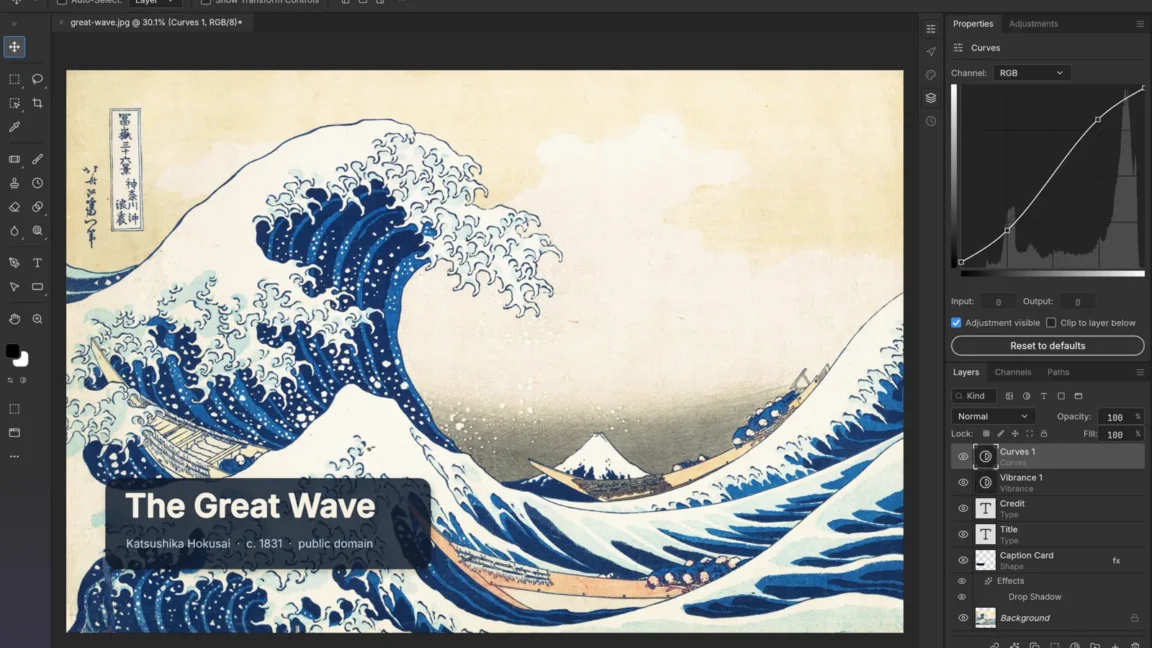
Brandon Thomas announced on Reddit a move that has reignited debate about the limits of proprietary software: seven open source applications replicating the interface and tools of Photoshop, Illustrator, Premiere, Lightroom, After Effects, InDesign, and Acrobat Pro. The project, which started as Artcraft for 'controllable' AI image and video editing, now aims to replace Adobe apps with equivalents free of licensing constraints. Thomas says he used Anthropic's Claude Opus 5.5 to generate 'clean-room' replacements in Rust, with WebAssembly versions that run in the browser. The first release, described as 'super early alpha,' shows clear gaps, but the message is ambitious: soon, according to the developer, the suite will be as functional as Adobe's.
Behind the news there is more than a clone. There is a shift in the cost of replicating complex software. An LLM does not just write boilerplate code: it can produce a similar interface, sketch out filters, and handle workflows. The critical point is elsewhere: much of the value of Photoshop or Premiere lies not in the menus, but in rendering engines, color management, proprietary file format compatibility, GPU acceleration, and the plugin ecosystem. Those components are the real moat. A clone that looks like Photoshop but does not handle complex PSD files or use VRAM efficiently remains an interface exercise, not a production tool.
The clean-room approach deserves attention. Historically it was used to reimplement BIOS or APIs without copying code: one group studies the behavior, another writes the implementation. With a language model, the separation is less clear. Claude Opus 5.5 generates code from prompts, but its weights result from training on a broad and opaque corpus. If that corpus includes documentation, technical discussions, or code from various sources, the definition of 'clean' becomes murky. This is not an accusation, but a constraint: the legal validity of an AI-assisted clean-room does not depend only on the developer, but on the provenance of the data used to train the model.
There is also a local execution angle. The WebAssembly versions and Rust code have a structural advantage: they run without depending on cloud services and can be executed in isolated environments. For creative studios, agencies, and marketing teams handling confidential material, a photo editing app that does not upload files to external servers is a lever for data sovereignty. But the price is maturity: without benchmarks, compatibility numbers, or proof on real workflows, the TCO of a migration remains incalculable. The project publishes no performance data and Thomas himself describes it as a very early alpha.
The news signals something structural: AI is not only generating content, but also the software that produces it. If a single developer can start a credible clone of seven desktop applications in a short time, the marginal cost of replication collapses. This does not destroy Adobe tomorrow, but it moves the bar: value will concentrate even more on formats, hardware acceleration, integration between tools, and legal trust. For those looking at on-premise deployment, the lesson is that Rust and WebAssembly become the building blocks of a local alternative to creative software giants, but the distance between a similar interface and an equivalent product remains wide. The Artcraft project is a signal, not yet an answer. For those weighing trade-offs between local tools and cloud, AI-RADAR offers analytical frameworks on on-premise deployment; the Artcraft case shows that data sovereignty is only one of the constraints to weigh, alongside compatibility and performance.







💬 Comments (0)
🔒 Log in or register to comment on articles.
No comments yet. Be the first to comment!