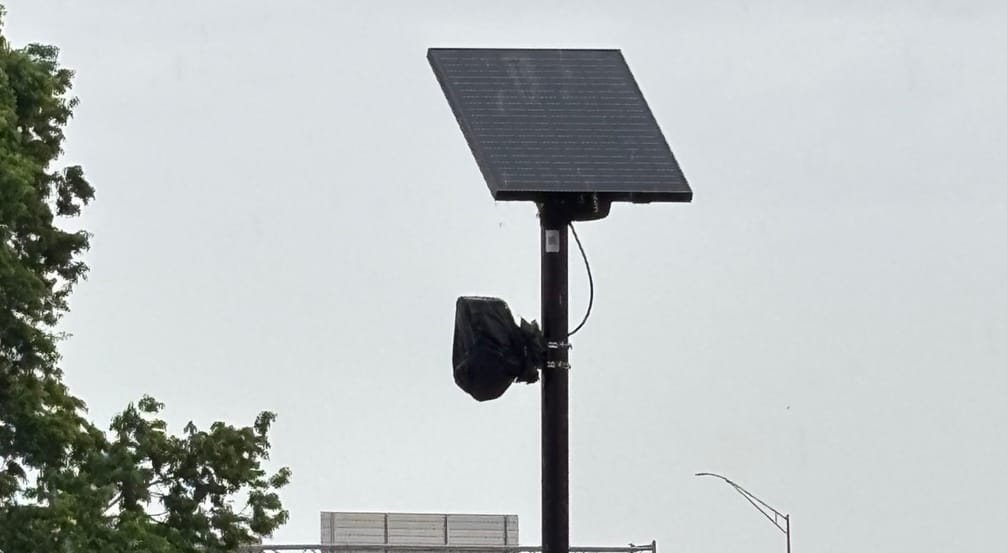
A Visible Sign of Lack of Control: Cities Cover Surveillance Cameras
In a gesture highlighting growing tensions between local administrations and surveillance technology providers, several U.S. cities have begun physically covering automated license plate reader (ALPR) cameras with black bags. The city of Dayton, Ohio, recently adopted this unusual measure for its Flock cameras, a decision that follows months of public outrage, a scandal related to the accidental sharing of data with immigration enforcement, and a $30,000 audit into the devices' use.
This move is not isolated. Evanston, Illinois, had already covered its Flock cameras last year, awaiting their removal by the company. These incidents highlight a deeper problem: the perception by cities that they lack unilateral control over the deactivation or removal of these infrastructures, bound by contractual terms that seem to limit their operational autonomy.
Contractual Implications and Data Management
The decision to cover the cameras in Dayton was described as a stop-gap measure. Joe Parlette, deputy city manager, stated that the Dayton Police Department collaborated with Public Works to "put bags over the cameras" pending their complete removal. The primary reason for this drastic action lies in uncertainty: the police are unsure if the cameras are still active, and the city itself doesn't know if it's allowed to remove them.
This scenario raises critical questions about managing contracts with technology providers and the implications for data sovereignty. When cities rely on third-party solutions for sensitive infrastructures, such as surveillance systems, they may face contractual clauses that limit their ability to act quickly in case of issues or changes in policy priorities. The sharing of Flock camera data with Immigration and Customs Enforcement (ICE) through the company's national network, as reported by 404 Media and local news outlets, has further complicated the situation, highlighting the risks associated with centralization and the potential unintentional dissemination of sensitive information.
Data Sovereignty and On-Premise Control: Lessons for AI
While the context involves physical cameras, the dynamics observed in Dayton and Evanston offer valuable insights for decision-makers evaluating the deployment of Large Language Models (LLM) and other artificial intelligence solutions. The difficulty of deactivating or removing a third-party system, coupled with concerns about data management and sharing, mirrors the challenges organizations face when choosing between cloud solutions and on-premise deployments.
Data sovereignty, regulatory compliance, and the need for air-gapped environments are crucial factors driving many companies to consider local stacks for their AI workloads. The ability to maintain direct control over hardware, software, and, most importantly, data, becomes a distinguishing element. An on-premise deployment offers greater decision-making autonomy, reducing the risk of stringent contractual constraints or dependencies on external providers who may not always align with the organization's control and privacy needs. For those evaluating on-premise deployment, analytical frameworks are available at /llm-onpremise to assess trade-offs between costs, performance, and control.
Future Outlook and the Need for Autonomy
The act of physically covering cameras with trash bags is a powerful symbol of frustration and perceived helplessness on the part of local administrations. It represents a visible "stop-gap," a temporary solution that highlights the absence of faster and more effective mechanisms for terminating the use of surveillance technologies when problems arise.
This scenario underscores the importance for CTOs, DevOps leads, and infrastructure architects to carefully evaluate not only the technical capabilities of a solution but also the contractual terms, data management policies, and flexibility offered by the provider. The ability to maintain control over one's technology stack and data is fundamental to ensuring operational resilience, compliance, and ultimately, the trust of users and citizens. The lesson from Dayton and Evanston is clear: technological sovereignty is not just a matter of ownership, but of decisive and operational autonomy.









💬 Comments (0)
🔒 Log in or register to comment on articles.
No comments yet. Be the first to comment!