AI Infrastructure Changes Shape
The artificial intelligence industry is undergoing a quiet but profound transformation. No longer just individual GPU cards mounted in standard servers, but entire racks pre-configured and optimized for AI workloads. This shift from a fragmented approach to rack-level solutions is reshaping deployment strategies, and companies like AIC are reaping the rewards, with double-digit growth.
What “Rack-Level” Really Means
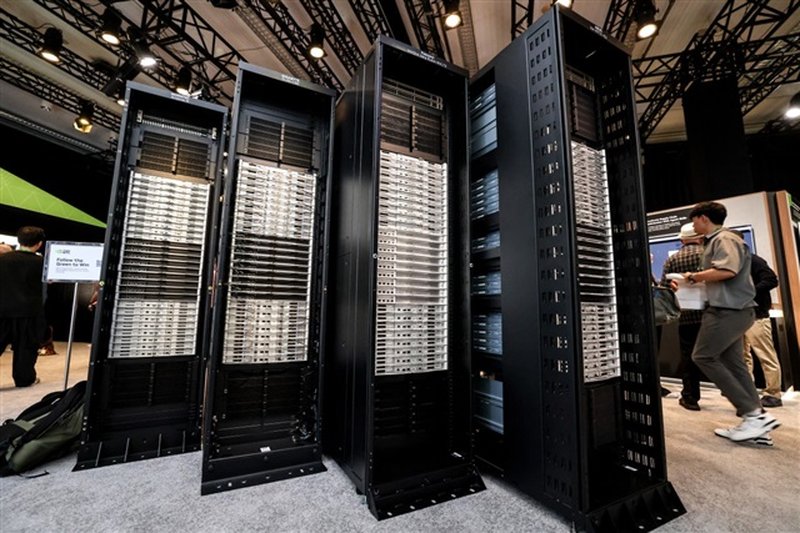
Rack-level systems integrate compute, storage, networking, and cooling components into a single standard cabinet (typically 42U) designed to work together closely. The goal is to maximize computational density while reducing latency and power consumption. For AI workloads, this often translates into multi-GPU nodes with high-bandwidth interconnects (NVLink, InfiniBand) and liquid cooling solutions to handle TDPs that can exceed 30 kW per rack.
The trend is not new, but the explosion of LLMs has accelerated the need for more efficient infrastructure for both training and inference. Rack-level systems allow horizontal scaling with greater predictability of costs and performance.
Why It Matters for On-Premise Evaluations
For organizations considering on-premise deployment of language models, the move to rack-level is not just a technical matter, but a factor that affects TCO, data sovereignty, and compliance. An AI-optimized rack can be installed in a private corporate data center, offering full control over data and models without external cloud dependencies.
This architecture also enables air-gapped environments, where security mandates that no data leaves the corporate perimeter. In sectors like defense, healthcare, or financial services, these features are often non-negotiable requirements. Having a compact, pre-tested rack-level system reduces integration risks and simplifies operations.
Trade-offs Not to Underestimate
Adopting rack-level solutions on-premise is not without challenges. The initial investment (CapEx) is significant, and adequate physical infrastructure must be ensured: enhanced power supply, efficient cooling systems, suitable spaces. Moreover, managing a complex machine park requires specialized in-house skills.
On the other hand, for constant and predictable workloads, the medium-to-long-term TCO can be lower than the rising operational costs of the cloud. Not to mention that in regulated or sensitive scenarios, the choice between on-premise and cloud is not purely economic but strategic.
The Signal from AIC
AIC's double-digit growth is not just an indicator of the company's health, but a signal of how the market is rewarding those offering infrastructure solutions ready for AI at rack scale. In a landscape where the LLM race pushes toward ever more demanding architectures, integrated systems represent a fundamental building block for next-generation deployment.
For those evaluating an in-house AI adoption path, following the evolution of these architectures is crucial. The direction is clear: infrastructure is no longer just a support, but a competitive factor.








💬 Comments (0)
🔒 Log in or register to comment on articles.
No comments yet. Be the first to comment!