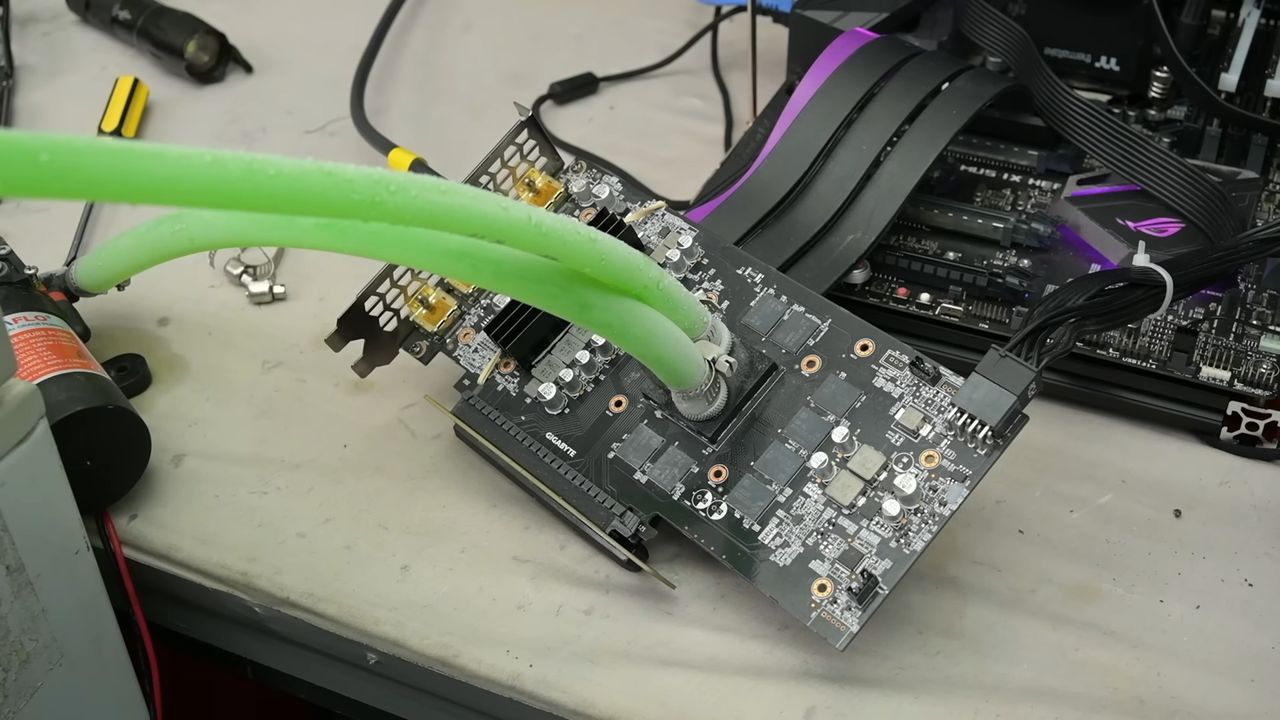
Bringing coolant into direct contact with a GPU die is nothing new in enterprise gear, but seeing it done at home with a 2019 consumer card like the GeForce RTX 2060 Super still turns heads. An anonymous modder custom-printed a water block, removed the integrated heat spreader, and flowed liquid straight onto bare silicon. Tom’s Hardware documented the result: after some early leaks, load temps dropped to 28°C – a dramatic thermal improvement for a GPU with 2,176 CUDA cores and 8 GB of GDDR6.
Beyond the tinkering thrill, there’s a real takeaway for anyone running LLM inference on local machines. The RTX 2060 Super, though no longer cutting-edge, can still handle quantized 7B-parameter models at a modest context window. Thermal management is often the hidden bottleneck: after several minutes of text generation, the GPU clocks sag to avoid overheating, and latency climbs. Direct-die cooling like this modder’s setup changes the equation. It removes the IHS thermal interface, cutting out a major resistance layer that soaks up degrees even in factory designs. The payoff: sustained clocks with no throttling, quieter operation, and the potential to pack multiple cards into tight spaces – all appealing traits for small-scale on-premise inference nodes.
The flip side is reliability. Those early leaks underscore how steep the learning curve is. Sealing a 3D-printed block against a bare die without gaskets or adhesives that degrade under heat cycles is no simple trick. In any production setting, a single drop of coolant on a motherboard means hours of downtime. Moreover, consumer-grade 3D prints carry dimensional tolerances that no industrial CNC would accept. Yet that very accessibility opens a door: as resin printers improve and materials withstand higher temperatures, custom cooling solutions could become a real tool for system integrators operating between consumer and prosumer markets.
What does the experiment signal structurally? That the gap between enterprise hardware and consumer components keeps shrinking, but the battleground is shifting to system engineering. Budget GPUs paired with clever fluid mechanics can approach the thermal density of a datacenter rack – only far quieter. In the context of data sovereignty and self-hosting, where noise and heat are often the top enemies in offices or home labs, solutions like this may not stay confined to hobbyist forums. For those weighing on-premise LLM deployment, the trade-off among hardware cost, cooling complexity, and corrective maintenance becomes sharper – and AI-RADAR tracks these thermal profiles in its analytical frameworks.
Ultimately, the modder’s work shines a light on a familiar principle: innovation often bubbles up from spare parts that were never meant to coexist. That those parts, a few years later, might become reference designs for low-cost local racks is not such a far-fetched possibility.






💬 Comments (0)
🔒 Log in or register to comment on articles.
No comments yet. Be the first to comment!