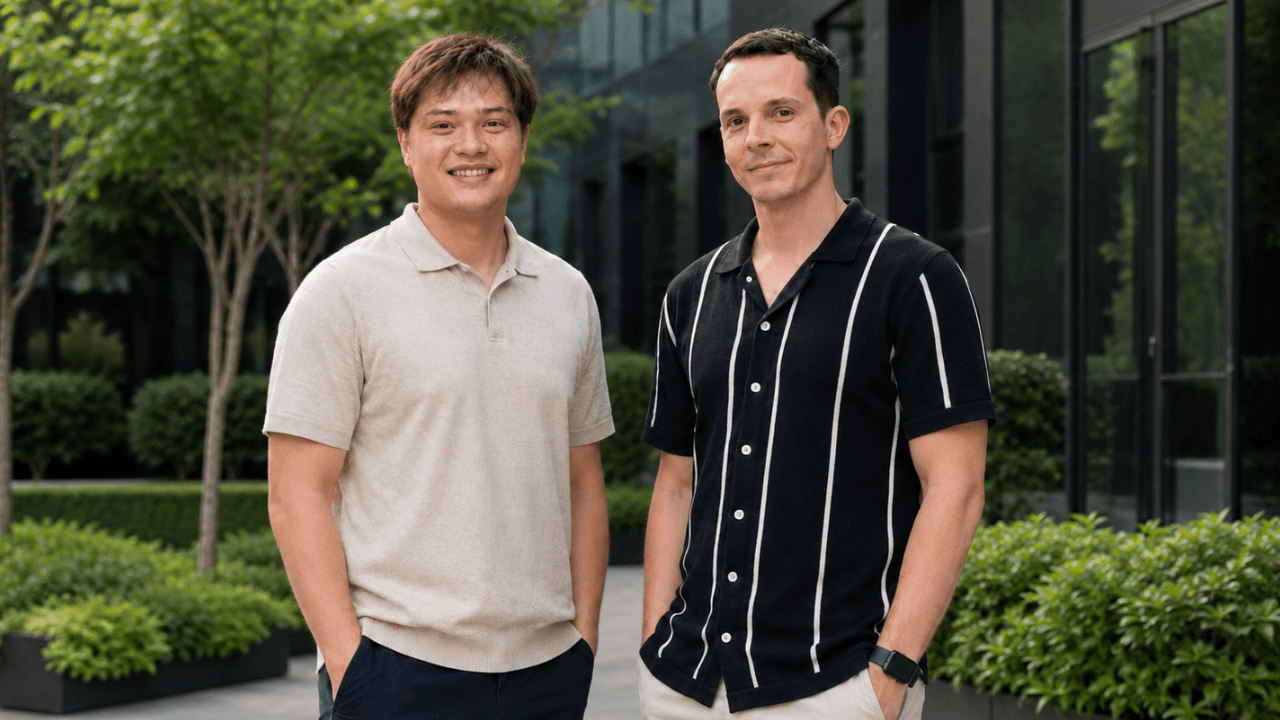
The problem with physical AI is rarely the model. It is the missing data. For a perception system monitoring a coastline, recognizing a boat in full daylight is easy; recognizing a small object in the top-left corner, far away, in an unrecorded condition is different. DiffuseDrive, a Hungarian startup, works in that blind spot: it generates synthetic data to train physical AI systems where real datasets fall short.
Gabor Vecsei, VP of AI Engineering, and Daniel Schmid, AI Research Lead, describe a sharp difference from Large Language Models. In natural language, the web provides a vast textual corpus; in physical AI, data are scarce, expensive and often dangerous to collect. Applications in defence, aerospace, mining and autonomous vehicles share the same constraint: the scenarios that really matter are rare and hard to reproduce.
DiffuseDrive starts from the customer. It analyses the existing dataset, the already trained neural network and its known shortcomings, then identifies the holes and generates data to close them. In an autonomous mining system, for example, wildlife or cattle can become a priority if the system has never encountered them. It is an iterative process: generation, addition to the dataset, retraining, new analysis.
Control, not realism
The most delicate technical part is control over the output. A standard generative model can place a balloon in a scene; making it appear far away and occupy only ten pixels is much harder. DiffuseDrive has built a dedicated solution to govern object position and size. This is crucial in defence systems, where an object can be small, distant or placed in an unusual part of the camera’s field of view.
Realism remains necessary, but not sufficient. The company does not rely only on the human eye: a visually convincing image is not necessarily useful for training. That is why there are automated quality checks and, when needed, people in the loop inspecting datasets. The final criterion is not image aesthetics, but the effect on the neural network that will consume it.
Infrastructure is the bottleneck, not just data
One of the most relevant aspects for those operating outside the cloud is the ability to deliver an air-gapped system to be installed on customer infrastructure. Machine learning teams can use it without going through DiffuseDrive. In this scenario, generation time depends on available compute: with a suitable GPU cluster it is a matter of hours; with a single GPU the constraint is hardware. For those evaluating on-premise deployment, AI-RADAR offers on /llm-onpremise a vantage point on these trade-offs, but here the infrastructure choice directly affects the speed of the data-model loop.
This approach overturns the rhetoric of volume. Vecsei makes it clear: you can collect millions of images while driving around without capturing anything useful for the customer. The value is not quantity, but the relevance of edge cases. DiffuseDrive reports improvements above 10 percent when synthetic and real data are combined; the main benefit is robustness on scenarios the model has not seen in training.
The competitive front is less obvious than it seems. The hardest competitors are often the customers themselves, who already have internal workflows and pipelines. DiffuseDrive has to demonstrate why a different approach produces measurable results, without being able to see the internal system it is compared against. Traditional simulation companies also compete on the same ground, but according to Schmid they do not always guarantee the photorealism perception systems need.
Seen in perspective, DiffuseDrive’s story signals a structural shift: in physical AI, advantage is not built by accumulating raw data, but by turning compute capacity and domain knowledge into controlled edge cases. Those with GPU clusters and proprietary datasets can shorten the loop and keep sensitive data inside their own boundaries; those selling only generalist models risk being left out of the most specific deployments. It is no coincidence that the company sees growing demand in defence, especially in markets such as Germany.
It is a particularly European dynamic. Vecsei expects companies to move toward specialised models and smaller versions of current ones, both to reduce compute costs and to adapt models to their own use cases. Europe’s compute capacity is not comparable to that of the United States and China; specialisation is an alternative path to the race on large foundation models.
DiffuseDrive’s next step looks at robotics and goes beyond visual generation. The goal is to understand recordings of existing robotic experiments — video, sensor streams and metadata — and turn them into dense annotations of actions, events and state changes. It is the same principle applied to another form of scarcity: the raw signal is not missing, the trainable meaning is.






💬 Comments (0)
🔒 Log in or register to comment on articles.
No comments yet. Be the first to comment!