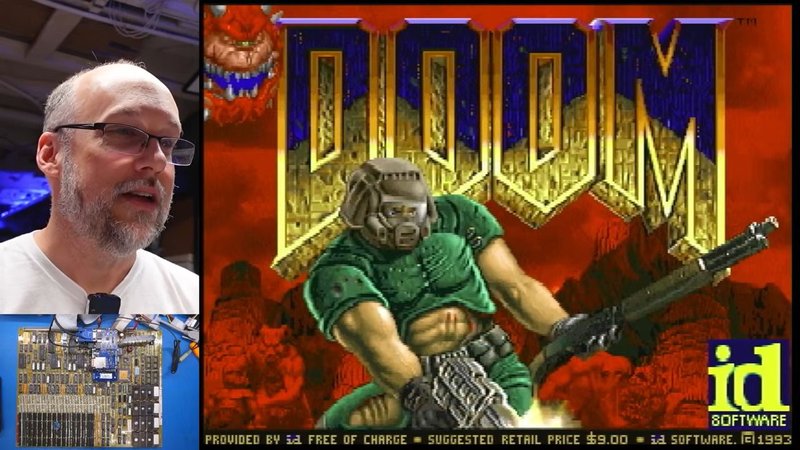
There is no training, no fine-tuning, no reinforcement learning. The checkpoint published on Hugging Face by physicsrob is a direct port of Doom's rendering algorithm into the weights of a transformer, produced with a compiler written by the author, torchwright. Every weight is computed, none is learned. The model uses a stock Phi3ForCausalLM architecture, loads in vanilla transformers with trust_remote_code=False, and takes as prompt the level geometry, player position, and view direction. Its generation emits drawing commands that a 43-line host program converts into pixels.
The checkpoint numbers make the distance between experiment and practical use very clear. At 320x200 resolution, the model requires 21 billion parameters and an 85.87 GB download. A single frame is a 3,614-token prompt plus 53,747 generated tokens: just under 40 minutes on a B200 GPU. The 80x50 version drops to 34 GB and is the one the author suggests trying.
That is where the most relevant constraint for deployment emerges. The author states that he has not run the model locally: he used B200 and A100-80 cloud GPUs. The compiler requires fp32 weights and quantization has not been explored. For the 80x50 checkpoint the recommended requirement is 80 GB of GPU memory; 64 GB could work in theory, but it has not been tested. This shifts the discussion from software to hardware: a 34 GB model in fp32 does not fit into a 24 GB consumer card and not even into many single-GPU workstations. The lack of quantization removes the main tool usually used to reduce the memory footprint of LLMs.
The experiment should not be read as an attempt to replace graphics engines. The computational cost per frame is huge and the output is far from any traditional approach. The point is different: transformer weights can be used as an executable description of an algorithm, not only as the result of a statistical process. This is not entirely new, but the result is verifiable and deterministic. There is no training dataset, no drift, and every weight is computed by the compiler. For regulated or air-gapped contexts, a checkpoint with weights derived from a program is easier to audit than a learned model, even though the fp32 requirement and the lack of quantization limit its portability.
Those who lose in the short term are the people hoping to use these checkpoints for interactive rendering: the compute-to-output ratio is unsustainable. Those who gain are teams studying the limits of LLMs as a general computing substrate and providers of GPUs with large VRAM, because the precision constraint pushes toward data center-class hardware. There is also a signal for software: vanilla transformers with trust_remote_code=False is enough, no custom runtime. AI-RADAR covers these trade-offs in the /llm-onpremise section, but the point here is more basic: without quantization the checkpoint remains confined to GPUs with abundant memory, whether cloud or on-premises.





💬 Comments (0)
🔒 Log in or register to comment on articles.
No comments yet. Be the first to comment!