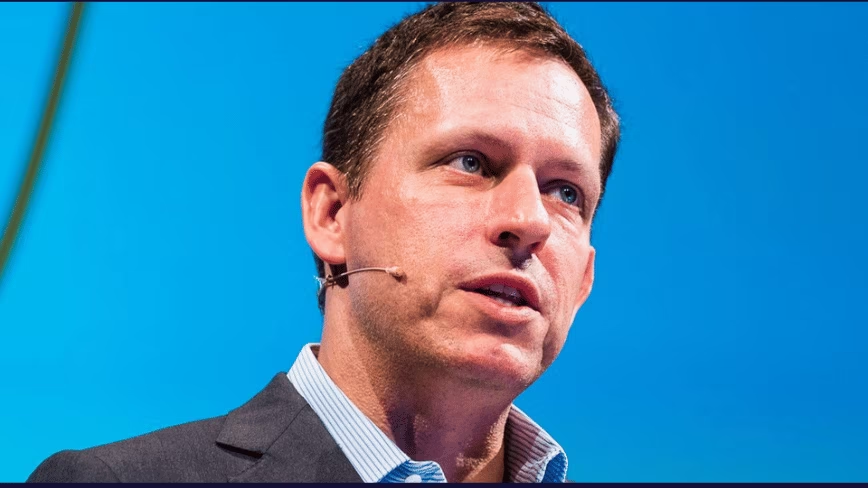
An Unprecedented Return in Venture Capital
The venture capital ecosystem is filled with audacious bets, but few achieve the scale and success of Founders Fund's investment in SpaceX. Peter Thiel's firm, known for its propensity to finance ventures with long-term visions and high disruptive potential, has executed an operation that stands out for its exceptional nature. This case study offers significant insights not only for the financial world but also for the broader technology sector, including artificial intelligence.
The initial investment, totaling approximately $600 million, was an act of faith in an ambitious vision: to revolutionize access to space. Today, in anticipation of a potential public offering, the value of that stake has grown exponentially, exceeding all expectations.
Vision and Returns: Beyond $50 Billion
As reported by Bloomberg, Founders Fund's stake in SpaceX is now estimated at over $50 billion, calculated based on a potential IPO price. This translates to an approximate 80-fold return on the invested capital, a figure that places this operation among the most lucrative in venture capital history. Such returns are uncommon and underscore the ability to identify and support projects with transformative impact.
SpaceX's success, fueled by continuous innovation and a rigorous execution strategy, has allowed Founders Fund to capitalize on a bet many would have considered too risky. This demonstrates how a clear vision and long-term commitment can generate extraordinary value in technology-intensive sectors.
Implications for the AI and LLM Sector: Strategic Infrastructure Decisions
The Founders Fund-SpaceX case, while not directly related to LLMs, offers an interesting parallel for the strategic decisions companies face today in artificial intelligence. Investing in disruptive technologies requires careful evaluation not only of market potential but also of the underlying infrastructure. For organizations deploying Large Language Models, the choice between on-premise deployment and cloud solutions is a strategic decision with significant implications for TCO, data sovereignty, and operational control.
Adopting a self-hosted approach for LLMs, for example, can offer greater control over sensitive data and compliance with stringent regulations, such as GDPR, in addition to potential long-term Total Cost of Ownership advantages. However, it requires an initial investment in specific hardware, such as GPUs with adequate VRAM and throughput capabilities, and in-house expertise for managing the inference and training pipeline. For those evaluating on-premise deployment, AI-RADAR provides analytical frameworks on /llm-onpremise to evaluate these trade-offs, helping companies make informed decisions.
Future Prospects and the Need for Strategic Vision
Founders Fund's success with SpaceX is a reminder of the value that strategic vision and targeted investment can generate in high-tech sectors. Similarly, in today's AI landscape, companies are called upon to make infrastructure choices that will shape their ability to innovate and compete. The decision to adopt on-premise solutions for LLMs, for instance, is not just a technical matter, but a strategic choice reflecting the priority given to data sovereignty, security, and long-term operational cost optimization.
Understanding the constraints and trade-offs of each deployment option is crucial for maximizing the return on AI investment. Whether it's space exploration or artificial intelligence, success depends on the ability to anticipate the future and build the appropriate technological foundations.








💬 Comments (0)
🔒 Log in or register to comment on articles.
No comments yet. Be the first to comment!