
Foxconn and the AI Rack Momentum
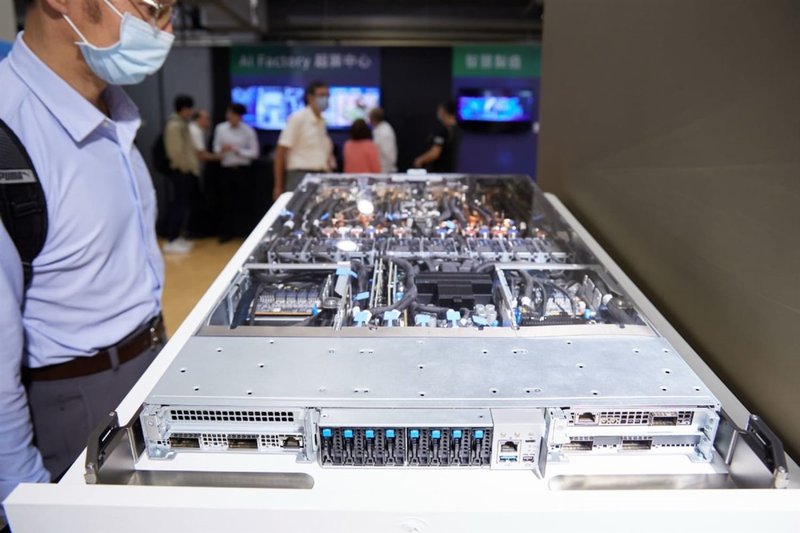
Foxconn, one of the world's largest contract electronics manufacturers, has announced record revenue for May. This positive financial outcome has been primarily attributed to a surge in demand for "AI racks," which are server systems optimized for artificial intelligence workloads. The data underscores a clear trend in the technology market: the widespread adoption of AI is generating a growing need for robust and specialized hardware infrastructure.
The increase in production and sales of these AI racks by Foxconn reflects a period of strong expansion for the sector. Companies, particularly those operating with Large Language Models (LLMs), are investing heavily to acquire adequate computing capabilities. This includes both the training phase, which demands enormous computational resources, and the inference phase, crucial for delivering AI services in production.
The Context of AI Hardware Systems
"AI racks" are not just ordinary servers; they are highly specialized hardware configurations, often equipped with a large number of high-performance GPUs. These graphics processing units are fundamental for accelerating the parallel computing operations required by machine learning algorithms and, specifically, by Large Language Models. Their efficiency is measured in terms of available VRAM, throughput, and compute capability, which are critical factors for managing complex models and voluminous datasets.
For organizations evaluating on-premise LLM deployment, investing in these racks represents a strategic choice. It offers direct control over hardware, data sovereignty, and the ability to optimize infrastructure for specific workloads, reducing reliance on external cloud services. This approach is often preferred by sectors with stringent compliance requirements or by those aiming for a more favorable TCO in the long run, despite a higher initial CapEx.
Implications for On-Premise Deployment and Data Sovereignty
The rising demand for AI racks highlights a clear trend towards self-hosted solutions for artificial intelligence. Many enterprises, especially those handling sensitive data or operating in air-gapped environments, prefer to maintain complete control over their AI infrastructure. This not only ensures greater security and adherence to privacy regulations but also allows for customizing the hardware and software environment to maximize the performance of specific LLM models.
The availability of specialized hardware, such as that provided by Foxconn, is crucial for enabling these scenarios. For those evaluating on-premise deployment, there are significant trade-offs between the initial hardware investment and long-term operational costs, including energy and maintenance. AI-RADAR offers analytical frameworks on /llm-onpremise to evaluate these trade-offs, helping decision-makers compare self-hosted options with cloud-based alternatives, considering factors like latency, throughput, and scalability.
Future Outlook and Challenges in the AI Hardware Market
Foxconn's current growth in the AI rack segment suggests that the artificial intelligence hardware market is poised for further expansion. The continuous evolution of Large Language Models, with increasingly larger and more complex models, will demand even more powerful and efficient computing infrastructures. This poses significant challenges for the supply chain and manufacturers, who must constantly innovate to meet performance and density requirements.
For CTOs, DevOps leads, and infrastructure architects, choosing the right hardware becomes a critical component of their AI strategy. Balancing performance needs with available budget, energy sustainability, and deployment flexibility is a complex task. The ability of companies like Foxconn to provide scalable and high-performance hardware solutions will be crucial for the success of enterprise AI initiatives, supporting the transition towards more resilient and controlled architectures.









💬 Comments (0)
🔒 Log in or register to comment on articles.
No comments yet. Be the first to comment!