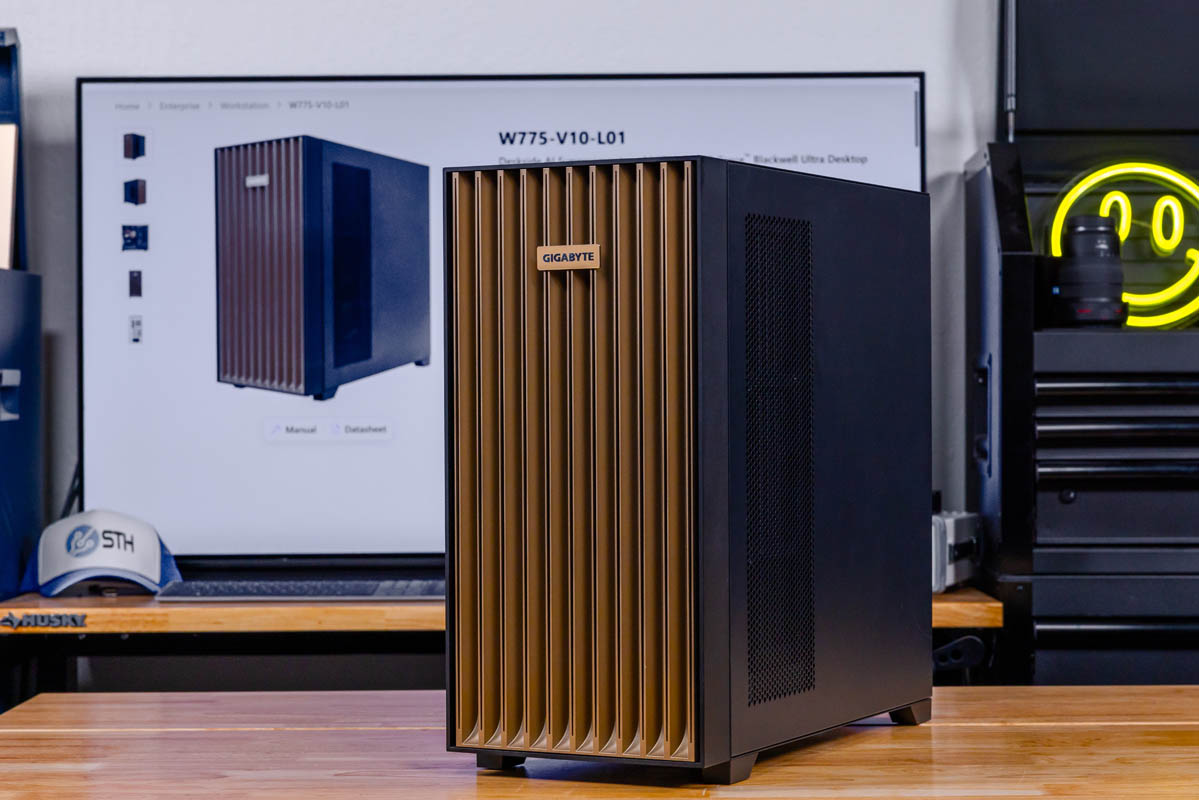
The Gigabyte W775-V10-L01 test bench is not just a benchmarking exercise: it is a concrete signal of how LLM hardware is changing form. The system, tested with an NVIDIA Blackwell Ultra GPU and a Grace CPU connected through a C2C interface, produced more than 2.2 billion tokens per day and pushed networking to 800 Gbps with a ConnectX-8 SuperNIC. In a deskside form factor, those numbers deserve a closer reading than a simple technical result.
The token-per-day figure matters most for teams running continuous inference. We are not talking about a distributed cluster, but a single system that can sit next to a desk. For teams developing or serving models locally, this changes the TCO calculation: the choice is no longer only between a remote rack and a consumer GPU, because there is now an intermediate path with processing capacity comparable to many server nodes.
The C2C link between CPU and GPU is equally relevant. In serving workloads, data transfer between system memory and GPU memory is often a bottleneck. A coherent, high-bandwidth interconnect lowers latency and allows larger contexts or more concurrent requests without fragmenting the pipeline. The presence of 800 Gbps networking also indicates that the system is not designed to run in isolation: it can aggregate with multiple nodes while maintaining high interconnect performance, a key aspect for teams that want to scale a self-hosted fleet without moving to the cloud.
There is, however, a constraint that the test does not resolve: a system of this class, in a deskside form factor, must deal with power and heat dissipation. The board can deliver data-center-class throughput, but the environment where it is installed must be prepared. That is the classic trade-off of high-density on-premise: more control and low latency, but also more engineering responsibility on site.
The news also points to a structural shift. NVIDIA is bringing the GB300 platform into a form factor that speaks directly to labs, departments, and companies that do not want to depend on cloud APIs. Losing ground in this scenario are providers that bet entirely on centralized racks and managed services: the availability of a deskside system with this performance lowers the technical barrier to self-hosting. Gaining are teams that already have local operational skills and can leverage data sovereignty without giving up compute capacity.
For those evaluating on-premise deployment, AI-RADAR offers analytical frameworks at /llm-onpremise to weigh these trade-offs. The Gigabyte W775-V10-L01, ultimately, is not just a device under test: it is an indicator that high-capacity inference is becoming a physically closer option for its users.





💬 Comments (0)
🔒 Log in or register to comment on articles.
No comments yet. Be the first to comment!