
Google Cloud and Intel: Extended Partnership for AI Infrastructure with Xeon and Custom Chips
Collaboration between tech giants is fundamental for the advancement of artificial intelligence, and in this context, Google Cloud and Intel have announced a multi-year extension of their strategic partnership. The agreement focuses on strengthening AI infrastructure, covering both CPU deployment and joint development of custom chips. This move underscores both companies' commitment to providing increasingly high-performing and efficient computing solutions for artificial intelligence workloads.
The expansion of this collaboration reflects the growing demand for computational resources dedicated to AI, from Large Language Models (LLM) to inference and training of complex models. For companies operating with intensive workloads, optimizing hardware and infrastructure is a critical factor for containing costs and improving performance.
Technical Details and Implementation
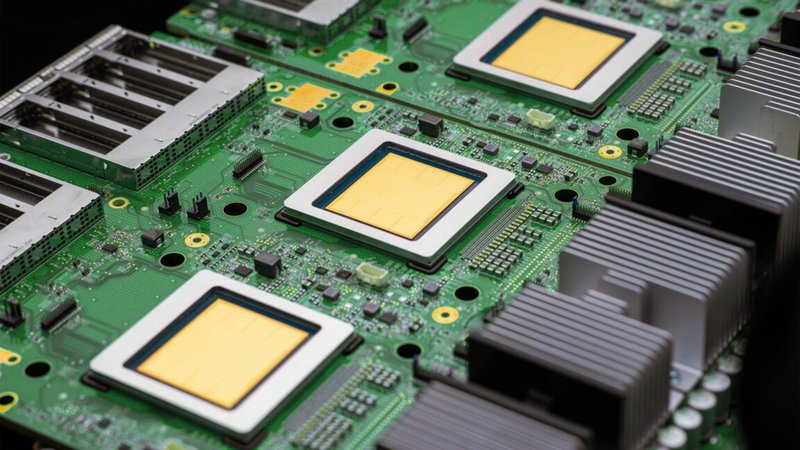
At the core of the agreement is Google Cloud's continued adoption of Intel Xeon 6 processors. These processors will be integrated into Google Cloud's global infrastructure, specifically to power C4 and N4 instances. The deployment of Xeon 6 processors aims to provide the necessary computing power for a wide range of AI applications, while ensuring energy efficiency and scalability.
In parallel, the partnership includes the expansion of joint development for custom Infrastructure Processing Units (IPUs). IPUs are specialized chips designed to offload infrastructure tasks from the main CPU, such as network, storage, and security management. By freeing the CPU from these operations, IPUs allow processors to dedicate more resources to application workloads, including intensive AI tasks, thereby improving throughput and reducing overall system latency. This approach is crucial for optimizing performance in large-scale cloud environments.
Context and Industry Implications
The investment in specific AI hardware, such as Xeon processors and IPUs, reflects a broader trend in the technology sector. Companies are seeking solutions that can efficiently manage the increasing complexity and data volume associated with artificial intelligence models. The choice between on-premise deployment and cloud solutions for AI is a constant debate for many CTOs and infrastructure architects.
While cloud solutions offer scalability and flexibility, self-hosted deployments can provide greater control over data sovereignty, compliance, and long-term Total Cost of Ownership (TCO), especially for predictable, large-scale workloads. The collaboration between Google Cloud and Intel, while focused on a cloud offering, highlights the importance of robust and optimized underlying hardware, a principle that also applies to those evaluating on-premise options. For those considering on-premise deployment, analytical frameworks are available at /llm-onpremise to help evaluate the trade-offs between different architectures.
Future Outlook
This strategic partnership between Google Cloud and Intel is indicative of the direction the AI infrastructure market is taking. Innovation is not limited to algorithms and models but extends deeply into hardware and system architecture. The ability to offer optimized computing solutions, whether through general-purpose CPUs or custom chips, will be a distinguishing factor for cloud service providers and companies managing their own infrastructures.
The continuous evolution of silicio and system architectures is essential for unlocking new capabilities in AI, enabling the development of larger, faster, and more efficient models. The collaboration between Google Cloud and Intel will help shape the future of AI deployment, influencing investment decisions and technological strategies across the industry.








💬 Comments (0)
🔒 Log in or register to comment on articles.
No comments yet. Be the first to comment!