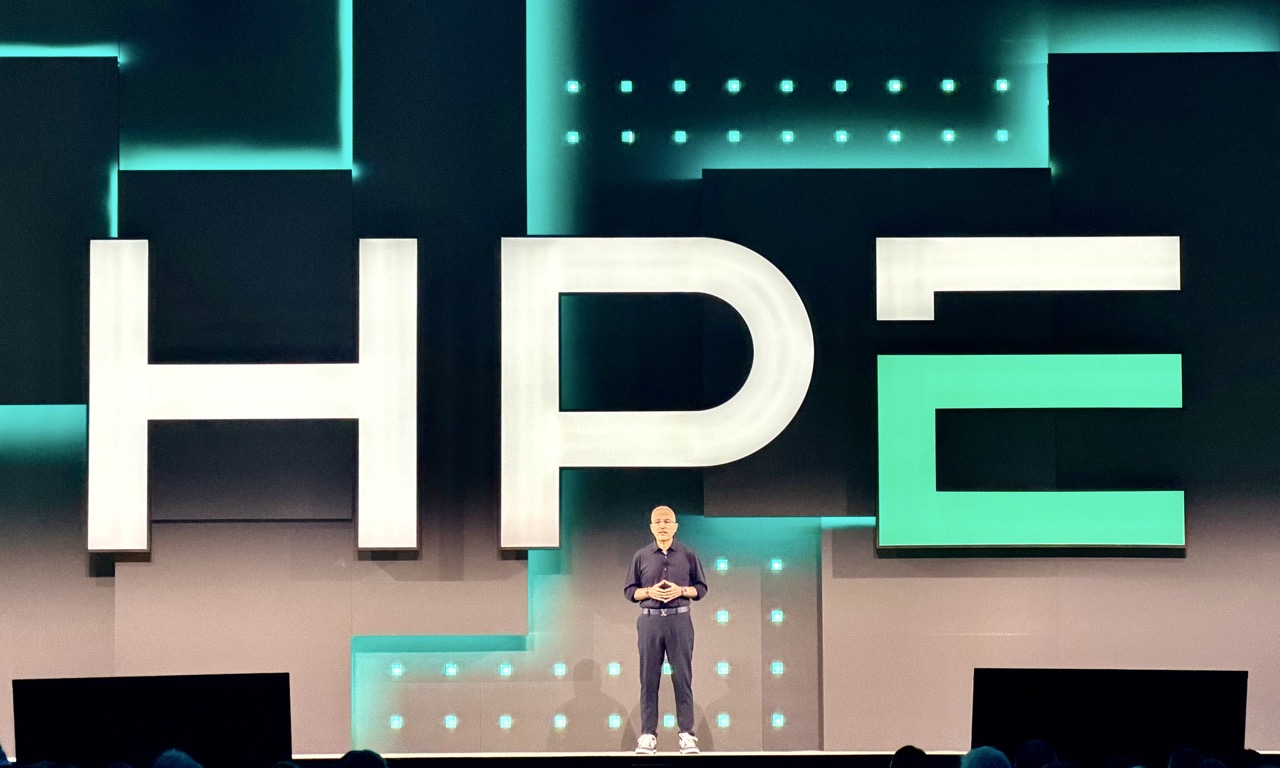
HPE Discover 2026: Strategic Vision for AI and Networking
The 2026 edition of HPE Discover offered an overview of Hewlett Packard Enterprise's strategic directions, with CEO Antonio Neri's keynote serving as the focal point. The attention was on next-generation networking technologies and innovations in artificial intelligence, two fundamental pillars for the evolution of enterprise IT infrastructures. This focus reflects the growing demand for solutions capable of handling increasingly demanding AI workloads, both in terms of computation and data transfer.
For organizations evaluating the deployment of Large Language Models (LLM) and other AI applications, the synergy between advanced networking and AI computing capabilities has become a top priority. HPE, with its long experience in enterprise hardware and solutions, is positioning itself to address these challenges, proposing an integrated approach aimed at optimizing performance and operational efficiency in complex environments.
The Crucial Intersection of Networking and AI
The effective implementation of AI workloads, particularly the training and inference of LLMs, largely depends on the robustness and speed of the underlying network infrastructure. Modern AI architectures, often based on distributed GPU clusters, require extremely high throughput and very low latency to ensure efficient communication between computing nodes. Next-generation networking solutions, such as those discussed by HPE, are designed to meet these needs, offering high-bandwidth interconnections and fabrics optimized for AI traffic.
Without adequate networking, even the most powerful GPUs can be bottlenecked, limiting the overall system performance. This is particularly true for training large models, where terabytes of data must be moved rapidly between processing units. Innovation in networking is not just about speed, but also about intelligently managing traffic, prioritizing critical flows, and reducing congestion, all essential elements for maintaining the efficiency of AI clusters.
Implications for On-Premise Deployments
HPE's focus on networking and AI has direct implications for companies considering an on-premise or hybrid deployment of their AI workloads. The ability to build robust local stacks, with optimized hardware and a high-performance network, is fundamental to ensuring data sovereignty, regulatory compliance, and granular control over the entire infrastructure. Many organizations, especially in regulated sectors, prefer to keep data and models within their physical boundaries, avoiding the risks associated with public cloud services.
Total Cost of Ownership (TCO) is another key factor. While the initial investment (CapEx) for an on-premise infrastructure can be significant, long-term operational costs (OpEx) may prove more advantageous compared to cloud consumption-based models, especially for intensive and predictable AI workloads. HPE's ability to provide integrated hardware and software solutions for AI and networking supports this strategy, offering companies the tools to build efficient and secure self-hosted environments. For those evaluating on-premise deployments, complex trade-offs exist, which AI-RADAR analyzes in detail in the /llm-onpremise section, providing analytical frameworks to support decisions.
Future Prospects and Infrastructure Control
Discussions at HPE Discover 2026 underscore a clear trend: AI is no longer an add-on but an intrinsic component of modern IT infrastructure. The deep integration between AI computing capabilities and high-performance networks is essential to unlock the full potential of Large Language Models and other intelligent applications. For CTOs, DevOps leads, and infrastructure architects, the choice of solutions offering control, performance, and security is becoming increasingly critical.
HPE's approach, which emphasizes next-generation hardware and networking, addresses the need for companies to build resilient and scalable AI infrastructures capable of evolving with business requirements. Maintaining control over the entire AI pipeline, from training to inference, through well-designed on-premise solutions, offers a strategic advantage in terms of flexibility, customization, and data protection, elements increasingly valued in the current technological landscape.








💬 Comments (0)
🔒 Log in or register to comment on articles.
No comments yet. Be the first to comment!