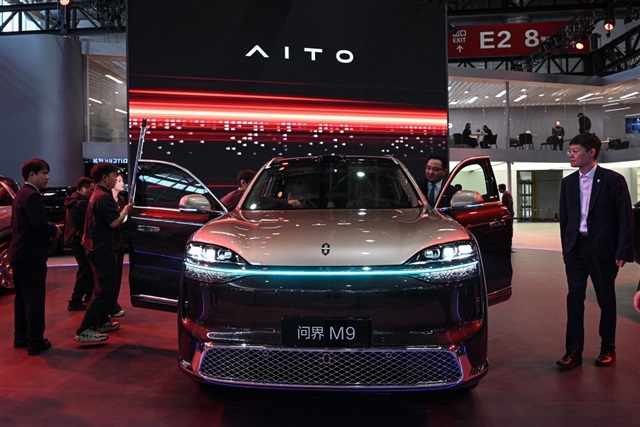
Onboard AI: The New Paradigm for Intelligent Vehicles
The automotive sector is undergoing a profound transformation, driven by the increasingly deep integration of artificial intelligence. Huawei, with its Aito M9, positions itself at the forefront of this evolution, presenting a luxury SUV that is not just a means of transport, but a true "rolling AI platform." This move underscores a broader trend: the need to process data and make real-time decisions directly on the device, away from centralized data centers.
The idea of a vehicle as an on-the-edge AI platform opens up interesting scenarios for the industry. It means that advanced functionalities, from assisted driving to user experience personalization, can benefit from reduced latency and greater operational autonomy, even in the absence of constant connectivity. For CTOs and infrastructure architects, this represents a concrete example of how AI workloads are migrating towards distributed and peripheral environments.
Technical Challenges of Vehicular On-the-Edge AI
Integrating significant AI capabilities into a vehicle like the Aito M9 involves a series of complex technical challenges. To function as a "rolling AI platform," an SUV must host specialized hardware, such as NPUs (Neural Processing Units) or compact GPUs, optimized for Inference. These components must be capable of handling complex AI models, potentially Large Language Models (LLM) or computer vision models, with stringent requirements in terms of power consumption, heat dissipation, and vibration resistance.
Model Quantization is a fundamental technique for adapting LLMs and other AI models to limited hardware resources, reducing the precision of model weights (e.g., from FP16 to INT8) to decrease VRAM usage and increase Throughput. This approach is crucial for ensuring that onboard AI can operate efficiently, providing fast and reliable responses for critical functions like safety or voice interaction. Designing robust, low-latency data processing Pipelines is equally essential to fully leverage the potential of these platforms.
Implications for Data Sovereignty and TCO
The shift of AI to the edge, as exemplified by the Aito M9, has profound implications for data sovereignty and Total Cost of Ownership (TCO). By processing data locally, vehicles can reduce reliance on cloud connectivity, enhancing user privacy and compliance with regulations like GDPR. Sensitive data, such as biometric or location data, can remain within the vehicle, minimizing exposure risks and the costs associated with cloud transfer and storage.
From a TCO perspective, although the initial investment in specialized edge hardware can be significant (CapEx), it can lead to operational savings (OpEx) in the long term by reducing bandwidth, cloud processing, and storage costs. For companies evaluating on-premise or edge Deployments for their AI workloads, it is crucial to carefully analyze these trade-offs. AI-RADAR offers analytical Frameworks on /llm-onpremise to support these evaluations, highlighting the constraints and opportunities of each approach.
The Future of Distributed AI
Huawei's initiative with the Aito M9 is a clear indicator of the direction artificial intelligence is heading: towards greater distribution and direct integration into end devices. This trend is not limited to the automotive sector but extends to a wide range of IoT and industrial applications, where the need for real-time processing, data security, and operational autonomy is a priority.
For IT professionals and system architects, understanding the dynamics of on-the-edge AI is now indispensable. The ability to design, deploy, and manage AI infrastructures that balance local computing power, connectivity, and security will be a critical success factor. The Aito M9, in this context, serves as an example of how hardware and software innovation can converge to create advanced user experiences while addressing the growing demands for data control and sovereignty.





💬 Comments (0)
🔒 Log in or register to comment on articles.
No comments yet. Be the first to comment!