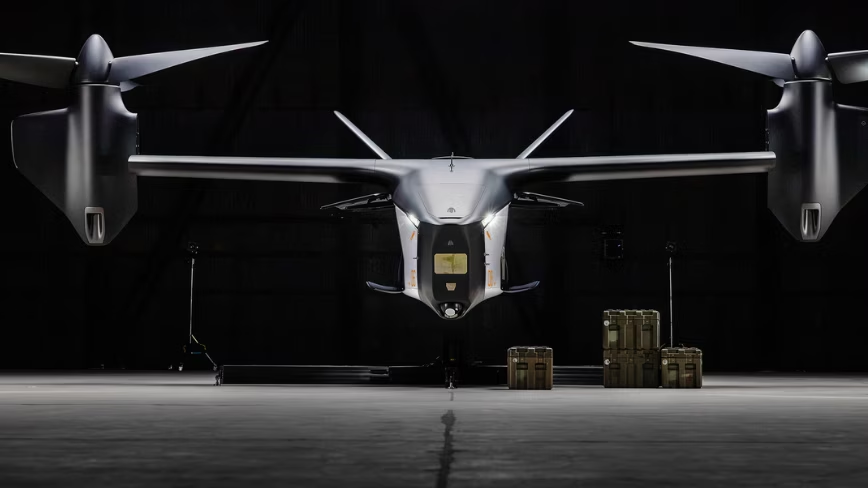
The unveiling of Thunder at the Farnborough International Airshow, a collaboration between Anduril and Archer Aviation, brings more than an aeronautical novelty. The aircraft’s full autonomy — a Group 5 rotorcraft capable of flying alongside crewed attack helicopters — shifts the debate toward on-board computing and autonomous decision-making, with no cloud link whatsoever.
The choice of a serial hybrid-electric powertrain is not just about energy efficiency. In a domain where every watt counts, the availability of clean, continuous power on board becomes the bedrock for hosting complex AI inference workloads, the kind that require specialized hardware to process sensor data, imagery, and signals in real time. When we talk about “on-premise” in the military context, we are not referring to a rack in a climate-controlled data center; we are talking about an accelerator board operating at extreme temperatures, under mechanical stress, and with the certainty that a single wrong decision can have irreversible consequences.
The absence of a human pilot is only the most visible symptom of a deeper transformation: the operational model is pivoting toward systems in which machine intelligence is no longer an accessory but the core of the command chain. This means that inference frameworks, the models themselves, and the hardware infrastructure must be designed to function air-gapped, with updates nearly impossible during a mission and an attack surface reduced to the bone. Data sovereignty becomes an absolute prerequisite, far more stringent than any GDPR regulation: information flows cannot leave the platform without compromising the entire operation.
Looking wider, Thunder is a test bed for a generation of drones, ground vehicles, and autonomous naval systems that must contend with SWaP (size, weight, and power) constraints dramatically more severe than those of an enterprise server. Model compression, aggressive quantization, and algorithm optimization become strategic levers. One can hardly imagine loading a 700W GPU cluster onto an aircraft that must also deliver flight endurance and payload capacity. This creates the need for embedded AI chips, often based on RISC-V or FPGA architectures, that balance performance and consumption within a few tens of watts.
The losers in this transition are the cloud-dependent ecosystems that have built their business models on variable latency and shared bandwidth. The winners are suppliers of edge hardware solutions, neuromorphic processor makers, and those designing end-to-end deployment toolchains that go from lab training to field inference. Structurally, the Anduril-Archer initiative signals that the boundaries between civil and military markets are thinning: the dual-use platform on which Thunder is based originates from technology developed for urban air mobility, then repurposed for warfare requirements. This accelerates the convergence between defense-grade hardware security and industrial reliability needs, with immediate knock-on effects on certified silicon production and the supply chain.
Autonomous vehicles in a tactical theater will increasingly be edge nodes of a network that tolerates no interruptions. Thunder, in this sense, is not merely an unmanned helicopter: it is a mobile computing architecture that exposes all the industry’s weaknesses when it comes to deploying AI in hostile, disconnected environments. It is no coincidence that the first flight date set for 2027 falls within a window in which, according to many defense department roadmaps, low-power AI chip maturity and secure deployment frameworks should reach a level sufficient for real-world operations.







💬 Comments (0)
🔒 Log in or register to comment on articles.
No comments yet. Be the first to comment!