
Imec Builds World's First High-NA EUV-Fabricated Quantum Dot Qubit Device
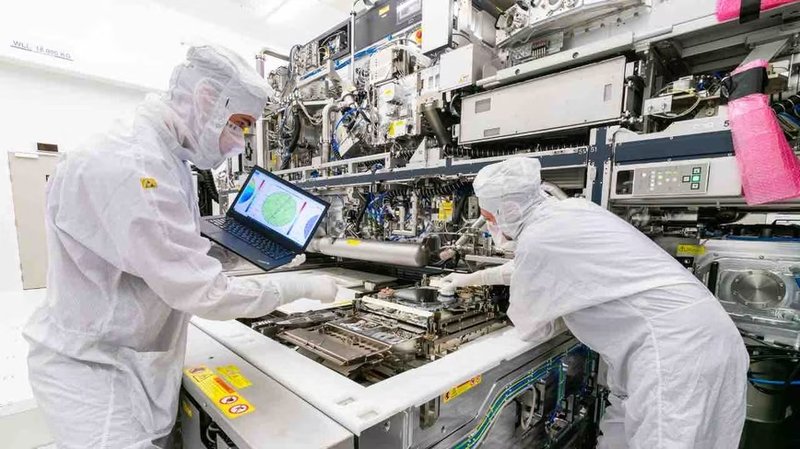
Imec, a leading research and innovation hub in nanotechnology and digital electronics, has announced a significant breakthrough in quantum computing. The organization has successfully built the world's first quantum dot qubit device fabricated using High Numerical Aperture (High-NA) Extreme Ultraviolet (EUV) lithography technology. This achievement marks a pivotal step towards integrating quantum component manufacturing with the established methodologies of the semiconductor industry.
The ability to produce qubits using advanced fabrication techniques like High-NA EUV is crucial for scaling quantum technology. Currently, qubit production often relies on artisanal processes, far removed from the high-volume assembly lines characteristic of the chip industry. Imec's announcement suggests a pathway to overcome this limitation, paving the way for more efficient production and, ultimately, greater availability of quantum hardware.
Technical Deep Dive: High-NA EUV and Quantum Dot Qubits
EUV lithography is the state-of-the-art technology used to produce the most advanced chips, including processors for artificial intelligence. The "High-NA" (High Numerical Aperture) version represents an evolution that allows for printing even smaller and denser features onto silicon, pushing the limits of Moore's Law. This precision is fundamental for creating quantum dot qubits, which are tiny semiconductor structures capable of confining single electrons and leveraging their quantum properties for information processing.
The challenge in qubit fabrication lies in the need for extremely precise control over the size and position of these structures at an atomic level. The use of High-NA EUV enables the resolution and repeatability required to create uniform and functional qubit arrays. This is an essential requirement for building large-scale quantum computers, where coherence and interaction between qubits are critical parameters for system reliability and performance.
Implications for the Future of AI and On-Premise Computing
The significance of this development extends beyond quantum computing alone. Imec emphasizes that this innovation could "pull" quantum computing onto the same manufacturing roadmap as next-generation AI processors. This implies that the same fabs and, potentially, the same production pipelines that currently manufacture GPUs and NPUs for Large Language Model (LLM) Inference and training, could one day also produce quantum components. This alignment could drastically reduce development times and costs associated with commercializing quantum hardware.
For organizations evaluating on-premise deployments of AI workloads, the availability of specialized hardware is a key factor. An integration of manufacturing roadmaps could mean greater predictability in the supply of advanced silicon, for both classical AI and quantum AI. This directly impacts the Total Cost of Ownership (TCO) and investment strategies in local infrastructures, potentially offering new options for data sovereignty and air-gapped environments as quantum computing capabilities mature and become more accessible.
Future Outlook and Challenges
While Imec's achievement is remarkable, the path to practical, large-scale quantum computers remains long. However, the demonstration that High-NA EUV technology can be employed for quantum dot qubit fabrication sends a strong signal to the industry. It suggests that the technological foundations for mass production of quantum hardware may already be under development, leveraging existing investments and expertise in the semiconductor sector.
This progress not only accelerates quantum research but also creates synergies with the evolution of AI. As Large Language Models and other AI models become more complex and demand greater computational power, the integration of quantum capabilities could offer radically new solutions for currently intractable problems. The convergence of these two areas, facilitated by shared fabrication techniques, promises to redefine the limits of what is possible in advanced computing.







💬 Comments (0)
🔒 Log in or register to comment on articles.
No comments yet. Be the first to comment!