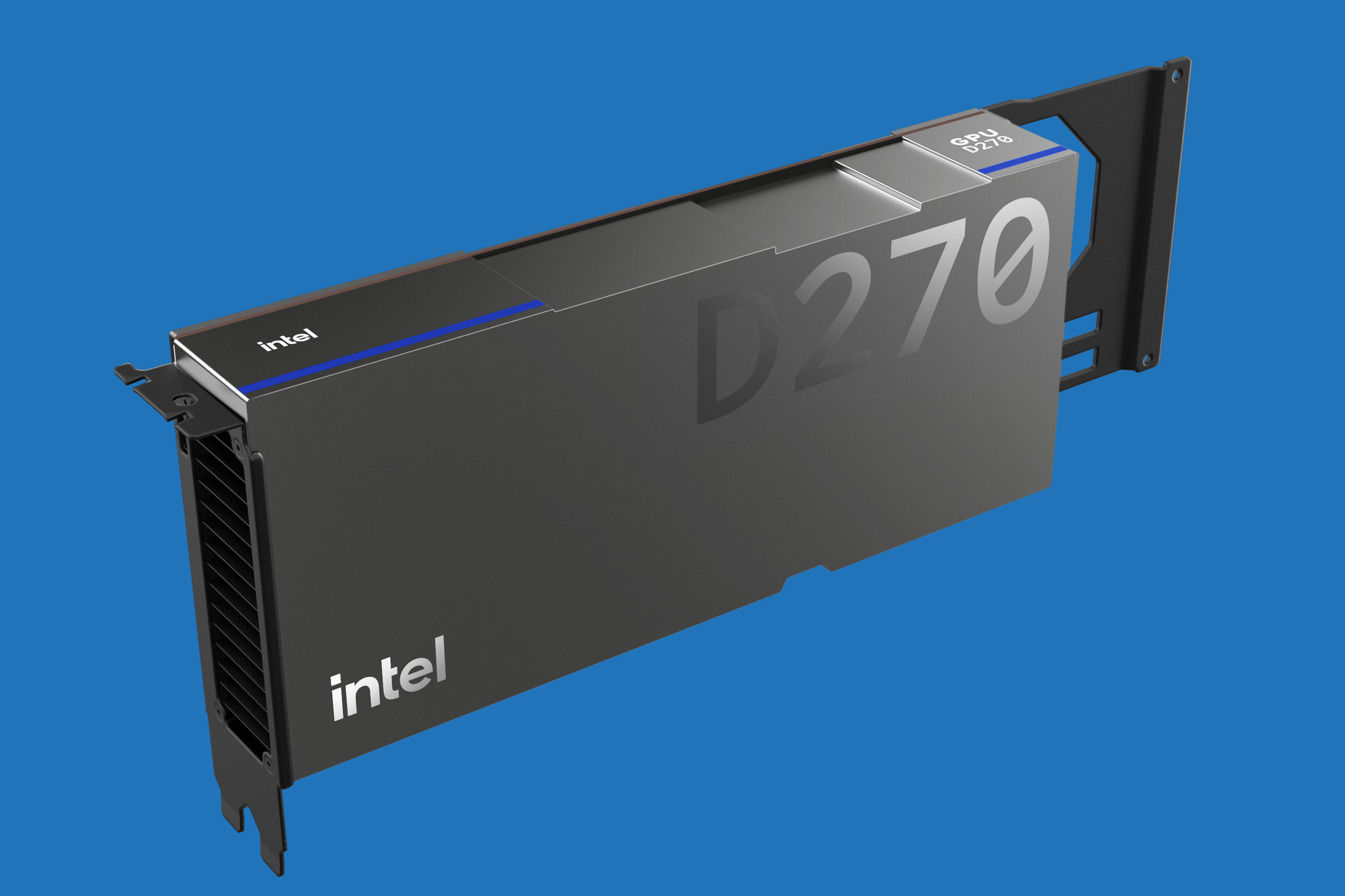
Intel has lifted the curtain on the data center AI inference card previously known by the codename Crescent Island. The new family is called Intel GPU D-Series, and the first model, D270, arrives with two headline numbers: 1.3 PFLOPS of dense FP8 compute and 1.5 TB/s of memory bandwidth. At first glance these look like routine specifications; in practice they reveal a precise strategy.
The emphasis on dense FP8 compute and memory bandwidth is not accidental. In Large Language Models inference workloads, token generation is often limited by how fast model weights can move from memory to compute cores. A 1.5 TB/s bandwidth reduces idle time for the cores waiting on data, a concrete advantage when serving multiple requests in parallel. FP8 also halves the memory footprint of weights compared to FP16 while maintaining acceptable quality for many quantized models. For teams running self-hosted LLM pipelines, this provides a useful starting point for estimating cost per token, not just raw compute.
Bandwidth is the real bottleneck
This is where Intel’s move fits. The D270 does not try to compete head-on with high-end training cards; it targets the inference segment, where TCO is not measured in raw petaFLOPS but in sustained throughput and energy per request. An accelerator with high memory bandwidth and dense FP8 compute is designed for deployments that must serve already-trained, often quantized models in continuous production without memory bottlenecks.
The presence of a third hardware path, alongside the dominant vendors, widens negotiation room and shifts attention from peak benchmarks to real operating costs. In environments with data sovereignty constraints, where models must run on local infrastructure, the arrival of inference-optimized cards can alter the convenience calculus between cloud and on-premise. Not because it is automatically the best option, but because it expands the possible choices. For those evaluating on-premise deployments, AI-RADAR offers analytical frameworks at /llm-onpremise to weigh these trade-offs.
Software remains the unknown
The real unknown at this point is software. An inference card is not just silicon; driver maturity, runtime support, and framework integration matter. Intel has invested heavily in this area, but the path to convince teams already running established pipelines will not rest on the spec sheet alone. The D270, with its official name and announced specs, is nevertheless a signal: inference is becoming a market with hardware requirements distinct from training, and vendors are starting to respond with dedicated products.








💬 Comments (0)
🔒 Log in or register to comment on articles.
No comments yet. Be the first to comment!