Intel Accelerates 18A-P Process: Entering Risk Production Phase
Intel recently announced a significant step in the development of its manufacturing technologies: the 18A-P manufacturing process, a new iteration of the 18A node, has officially entered the “risk production” phase. This stage represents a crucial moment for any chipmaker, as it involves running the process on real hardware to verify its functionality and reliability before committing to mass production volumes.
The announcement, made on Tuesday, is not about the launch of a specific chip, but rather the validation of a technological promise that Intel has long cultivated. For the company, it's about demonstrating its ability to innovate and adhere to its roadmap in advanced silicon manufacturing, an increasingly strategic sector for the entire technology industry, particularly for artificial intelligence workloads.
The Significance of “Risk Production” for Advanced Silicon
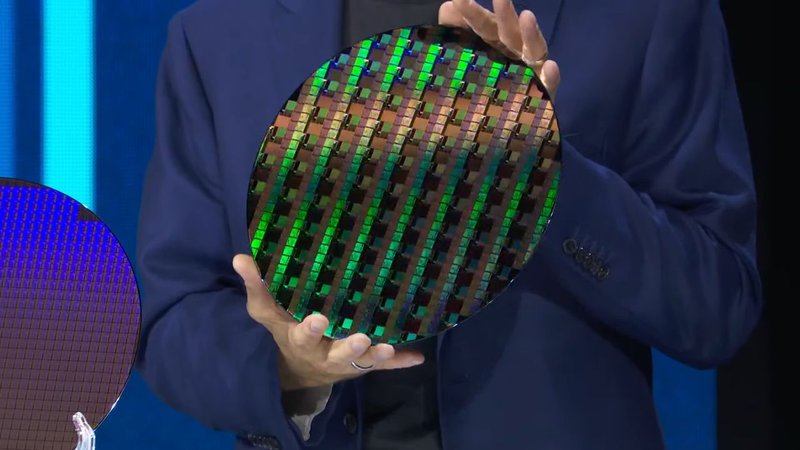
“Risk production” is a fundamental milestone in the lifecycle of a manufacturing process development. In this phase, chipmakers intensively test the new node on real wafers, using test designs or early chip prototypes. The goal is to identify and resolve any yield issues, defects, or inefficiencies that could compromise large-scale production. It is a significant investment in terms of time and resources, but indispensable for ensuring the scalability and quality of future products.
For decision-makers evaluating infrastructure for on-premise Large Language Models (LLM), the availability of cutting-edge manufacturing processes like Intel's 18A-P is of paramount importance. These processes form the basis for the production of next-generation GPUs and CPUs, which in turn determine available VRAM, compute throughput, and energy efficiency—all critical factors for the Total Cost of Ownership (TCO) and performance of self-hosted AI systems. A vendor's ability to produce chips with advanced nodes directly translates into more powerful and competitive hardware for inference and training of complex models.
Market Implications and On-Premise Deployments
Intel's advancement in the 18A-P process has significant implications for the competitive landscape of the semiconductor industry. In an era where demand for high-performance chips for AI is constantly growing, a company's ability to produce cutting-edge silicon is a distinguishing factor. This development could strengthen Intel's position as a foundational technology provider for AI infrastructure, offering alternatives and stimulating innovation across the entire ecosystem.
For companies prioritizing data sovereignty and complete control over their AI workloads, opting for on-premise or air-gapped deployments, the availability of hardware based on robust and advanced manufacturing processes is essential. Hardware choice directly influences the ability to run large LLMs, response latency, and the overall security of the environment. A reliable manufacturing process ensures that future chips can meet the growing performance and reliability demands of enterprise AI deployments.
Future Prospects in the AI Silicon Sector
The entry of 18A-P into risk production signals that Intel is proceeding with determination on its technological roadmap. This progress is crucial not only for the company's competitiveness but also for the entire technology sector, which increasingly relies on more powerful and efficient chips. As Large Language Models become more complex and computing requirements increase, the ability to produce silicon with ever-smaller and higher-performing nodes becomes a critical enabler.
For IT professionals and infrastructure decision-makers, monitoring these developments is vital. The availability of new generations of hardware, stemming from processes like 18A-P, will directly influence purchasing strategies and system architectures for AI deployments. Competition in silicon manufacturing will continue to push performance limits, offering new opportunities to optimize the costs and capabilities of on-premise AI systems, an aspect that AI-RADAR continues to analyze in depth to support its readers' strategic choices.




💬 Comments (0)
🔒 Log in or register to comment on articles.
No comments yet. Be the first to comment!