AI and Copper Limits: A Growing Challenge
The explosion of Large Language Models (LLMs) and the acceleration of artificial intelligence workloads have placed unprecedented pressure on computing infrastructure. The need to process massive volumes of data at ever-increasing speeds, for both training and inference, requires interconnects capable of ensuring high throughput and minimal latency. Traditionally, copper has been the backbone of these connections, but it is now showing its physical limitations.
As GPU clusters become denser and AI models more complex, copper interconnects begin to suffer from issues related to signal loss, power consumption, and heat dissipation. These factors can become a significant bottleneck, limiting the overall performance of AI systems and increasing the Total Cost of Ownership (TCO) for companies seeking to scale their computational capabilities. The search for more efficient and higher-performing alternatives has become a strategic priority for the entire industry.
Silicon Photonics: The Solution for the Future of AI Infrastructure
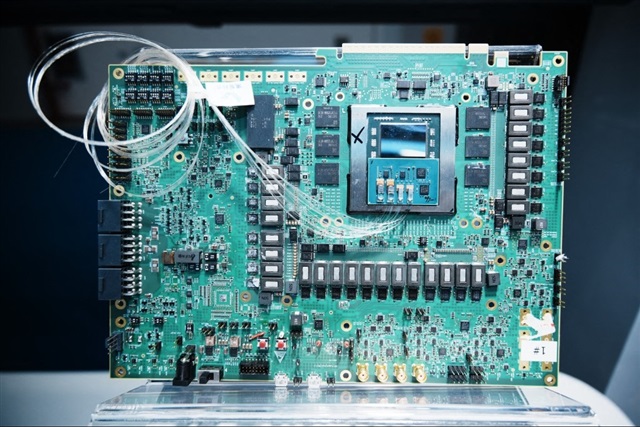
In this context, silicon photonics emerges as one of the most promising technologies to overcome the limitations of copper. This technology uses light, rather than electrons, to transmit data, enabling higher transfer speeds, drastically lower power consumption, and greater integration density. Silicon photonic chips can integrate optical and electronic components on a single platform, facilitating the creation of very high-bandwidth interconnects.
Silicon photonics is particularly well-suited for the demands of modern data centers and high-performance computing clusters, where connectivity between GPUs, CPUs, and memory is critical. It allows for longer-distance connections with less signal loss and supports more complex and scalable network architectures, essential for distributed LLM training and large-scale inference. Its ability to improve energy efficiency is a significant advantage, considering the growing energy footprint of AI infrastructures.
Strategic Implications and the Foundry Market
The increasing importance of silicon photonics is highlighted by a significant strategic move: foundries, key players in semiconductor manufacturing, are locking down production capacity for these components until 2028. This action underscores the forecast of sustained demand and the commitment to secure the necessary resources to support the expansion of AI infrastructure in the coming years. For companies, this implies the need to carefully plan their investments and deployment strategies.
For CTOs, DevOps leads, and infrastructure architects evaluating self-hosted or on-premise solutions, the availability and cost of silicon photonics will become critical factors. The ability to build high-performance AI clusters, with high throughput and low latency, will increasingly depend on these advanced technologies. Securing access to such components is essential for maintaining control over one's infrastructure, ensuring data sovereignty, and optimizing long-term TCO. For those evaluating on-premise deployments, AI-RADAR offers analytical frameworks on /llm-onpremise to assess the trade-offs between performance, costs, and control.
Future Prospects and the Race for Innovation
The lockdown of production capacity until 2028 is not only a signal of demand but also an indicator of the strategic importance silicon photonics will play as a fundamental enabler for the next generation of artificial intelligence. Innovation in this field is continuously evolving, with research focused on further improving performance, reducing costs, and integrating with other emerging technologies.
Overcoming the physical limits of traditional interconnects will be crucial for the scalability and sustainability of AI systems. Companies that can effectively integrate silicon photonics into their infrastructure architectures will be better positioned to fully leverage the potential of AI, while ensuring operational efficiency and market competitiveness. The race for innovation in interconnects is, ultimately, a race for the future of artificial intelligence itself.







💬 Comments (0)
🔒 Log in or register to comment on articles.
No comments yet. Be the first to comment!