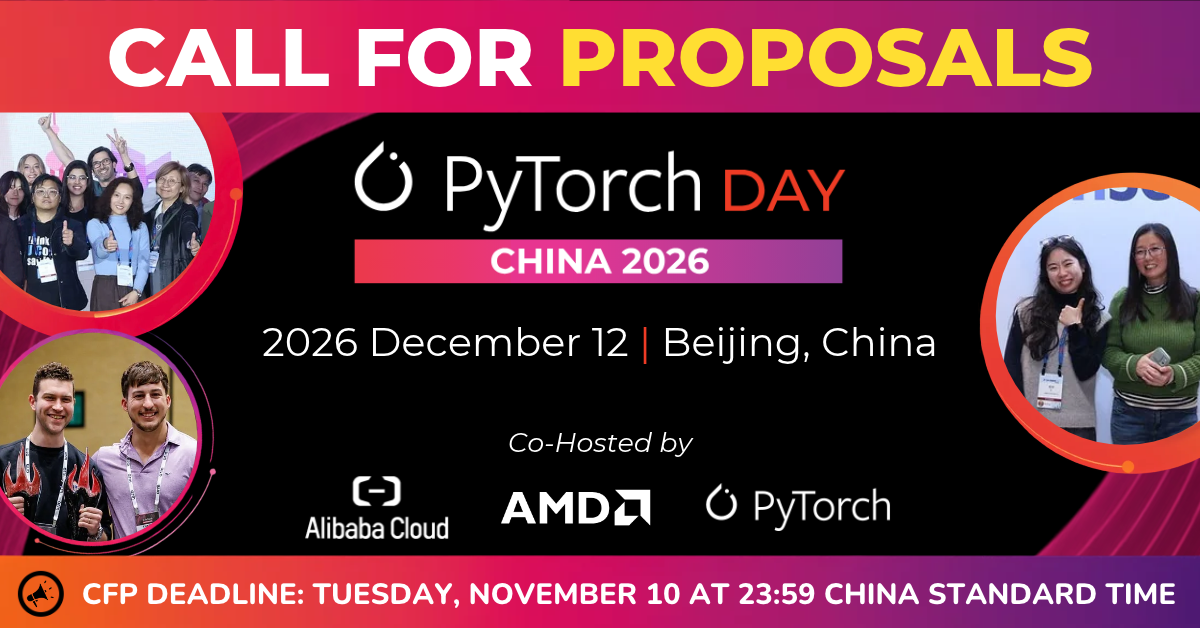
The November 10 deadline at 23:59 China Standard Time for PyTorch Day China 2026 proposals is more than a scheduling detail. It is the community’s way of pointing to where the real pressure points now sit: not only in training models on homogeneous clusters, but in the intersection of inference, quantization, hardware acceleration, and physical systems. The December 12 event in Beijing brings together PyTorch developers, machine learning engineers, AI researchers, and open source AI leaders.
The CFP welcomes session presentations and lightning talks across five areas: Model Training & Post-Training, covering distributed training, SFT, reinforcement learning, and preference optimization; Efficient Inference & Deployment, spanning LLM inference, quantization, optimization, and production deployment strategies; PyTorch Core & Hardware Acceleration, including compilation, kernel optimization, performance profiling, and GPU and AI accelerator technologies; Physical AI, from robotics and intelligent devices to Vision-Language-Action models, perception and control, and simulation-based training; and PyTorch Ecosystem & Applications.
The structure of the call is already a position. Giving training and inference equal weight, while placing them next to a dedicated hardware acceleration track, means recognizing that the framework’s value increasingly lies downstream of training. For teams running models in local environments, the difference between a prototype and a usable service often comes down to exactly these levers: aggressive quantization, deployment strategies that respect VRAM and latency constraints, and kernels able to exploit heterogeneous accelerators. The call asks for contributions on GPU and AI accelerator technologies—a formulation that expands the scope beyond a single vendor’s silicon.
This is not just a Chinese issue, but the Beijing context makes it easier to read. In an ecosystem where part of compute capacity is tied to local suppliers and data residency pressures push toward self-hosted or hybrid execution, the framework cannot afford to assume a homogeneous cloud backend. The structural consequence is that PyTorch must evolve as a collector of compilers, runtimes, and profilers that treat hardware heterogeneity as a normal condition rather than an exception. Teams running their own infrastructure have a direct incentive to follow this track: every kernel or quantization improvement translates into operational margin without changing hardware.
The Physical AI chapter adds a further signal. Robotics, intelligent devices, and Vision-Language-Action models do not live in remote datacenters: perception, control, and simulation require short cycles and, often, processing next to the sensor. That pressure shifts the center of gravity toward local inference and optimized models, leaving less room for architectures that delegate everything to the cloud. Developers building robots or embedded devices find themselves exactly at the crossing of the CFP tracks: efficient deployment, hardware acceleration, and physical models.
Notifications are scheduled for November 17, with the program announced on November 18. The call does not promise definitive answers, but its composition is already a data point: for PyTorch’s next cycle, production efficiency and heterogeneous hardware are not side topics. For those evaluating on-premise deployment, the link between quantization, deployment strategy, and acceleration is one of the analytical areas AI-RADAR follows closely at /llm-onpremise.





💬 Comments (0)
🔒 Log in or register to comment on articles.
No comments yet. Be the first to comment!