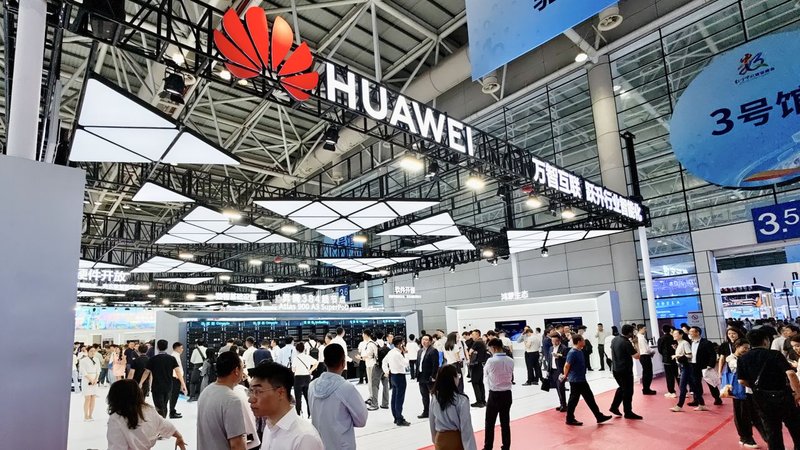
China Telecom has announced a significant milestone in the artificial intelligence landscape: the end-to-end training of its Xing4.1 model, a 285-billion-parameter Mixture-of-Experts (MoE) Large Language Model (LLM). What makes this news particularly relevant is the infrastructural choice underpinning the operation: the model was trained on an impressive cluster comprising 8,192 Huawei Ascend 910C chips, without relying on any NVIDIA GPUs or the CUDA ecosystem.
This development is not merely a technical detail but a powerful signal of the dynamics at play in the AI sector. For years, the industry has operated under NVIDIA's near-monopoly regarding hardware and training software for the most demanding workloads. China Telecom's ability to train an LLM of such magnitude on a completely alternative platform demonstrates the maturation of non-NVIDIA hardware and software ecosystems, particularly those developed by Huawei.
Implications for Sovereignty and TCO
The implications are manifold and directly address the priorities of tech decision-makers evaluating on-premise deployment strategies. Firstly, data sovereignty and control over the entire technological pipeline are becoming increasingly central. For entities like China Telecom, reliance on a single external vendor, especially in a complex geopolitical context, represents a strategic risk. Investing in local stacks, such as the Ascend-based one, offers greater resilience and control over data and infrastructure.
Secondly, this move highlights the importance of long-term Total Cost of Ownership (TCO). While building a software ecosystem alternative to CUDA requires significant initial investments in research and development, the ability to scale large model training on proprietary or non-NVIDIA hardware can lead to substantial economic advantages, reducing dependence on potentially increasing licensing and hardware costs.
Finally, China Telecom's announcement underscores the growing fragmentation of the AI hardware landscape. While NVIDIA continues to dominate, the emergence of credible alternatives capable of handling massive-scale training workloads offers new options for companies seeking to diversify their suppliers or build resilient, customized AI infrastructures. For those evaluating on-premise deployment, the availability of these alternatives introduces new trade-offs to consider, not only in terms of raw performance but also ecosystem integration, software support, and geopolitical implications. AI-RADAR continues to monitor these developments, providing analytical frameworks to help navigate the complexities of such decisions.







💬 Comments (0)
🔒 Log in or register to comment on articles.
No comments yet. Be the first to comment!