
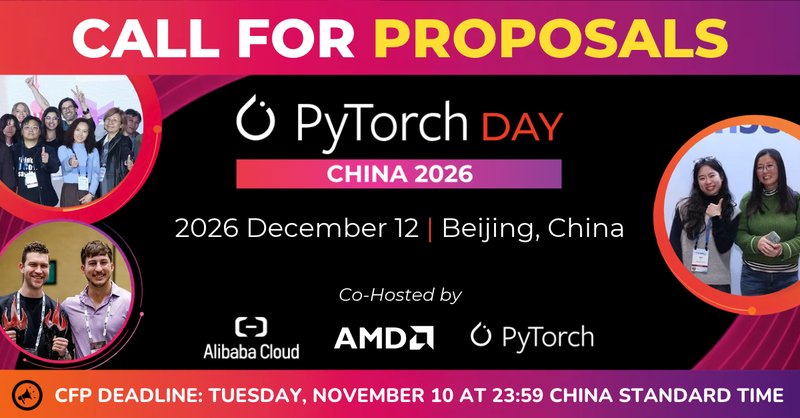
On December 12, Beijing will host PyTorch Day China 2026, an event poised to be a benchmark for innovation in Open Source AI. Co-hosted by Alibaba Cloud, AMD, and the PyTorch Foundation, the gathering will bring together developers, researchers, and industry leaders to explore advancements in training, Inference, and responsible AI.
The event's agenda reveals a particular focus on hardware acceleration and Deployment strategies, key elements for companies evaluating on-premise or hybrid AI solutions. Among the highlighted sessions are those dedicated to optimizing PyTorch on AMD GPUs with FlyDSL, presented by Xiaobing Zhang, Shijie Feng, and Xudong Yuan from AMD. Another significant talk, by Teng Ma of Mooncake, will delve into the evolution of Inference caching towards agentic AI data infrastructures, a topic directly impacting the efficiency and management of LLM workloads.
Particularly relevant for the AI-RADAR landscape is Ao Shen's session from Inferact, which will illustrate how to accelerate Reinforcement Learning training through bitwise-identical rollout and training across NVIDIA and AMD GPUs. This approach underscores the importance of compatibility and interoperability between diverse hardware architectures, a critical factor for flexibility and TCO in enterprise infrastructures. The joint presence of NVIDIA and AMD in this context signals a market maturation towards multi-vendor solutions, where hardware choice can be driven by specific workload constraints and costs, rather than reliance on a single provider.
Another prominent session, presented by Hongbin Zhang and Yixuan Chen from the Institute of Software, Chinese Academy of Sciences, will explore upstream PyTorch support on RISC-V and its Deployment with RuyiAI. This focus on RISC-V highlights the pursuit of alternative, potentially more open and customizable architectures, which can offer advantages in terms of control, data sovereignty, and costs for specific Deployment scenarios, including air-gapped or self-hosted environments. The push towards RISC-V, particularly in regional contexts like China, suggests a strategy to build more independent and resilient technological ecosystems.
PyTorch Day China 2026 is not only an opportunity to deepen technical knowledge but also an indicator of structural trends in the AI sector. The emphasis on hardware diversification (AMD, NVIDIA, RISC-V), Inference optimization, and localized Deployment solutions reflects a growing need for control and flexibility. For CTOs, DevOps leads, and infrastructure architects, these developments offer new opportunities to optimize their AI pipelines, balancing performance, TCO, and data sovereignty requirements, especially for those evaluating on-premise alternatives to traditional cloud models.









💬 Comments (0)
🔒 Log in or register to comment on articles.
No comments yet. Be the first to comment!