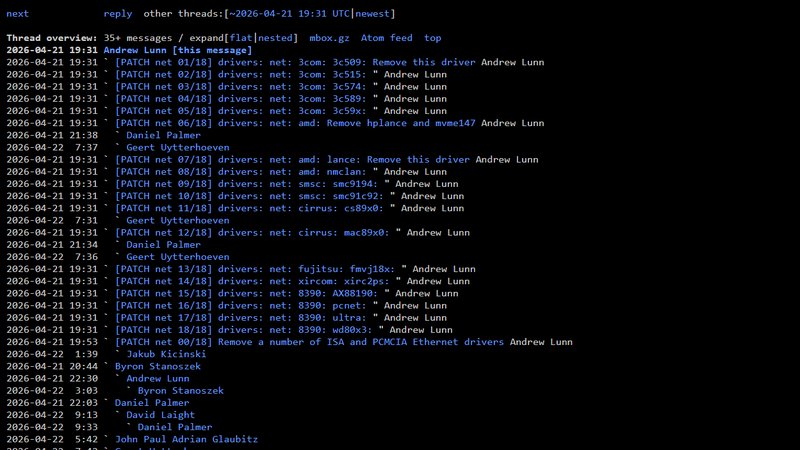
The Linux 7.3 kernel merge window closed with a paradox that has less to do with code than with the economics of open source maintenance. The networking subsystem absorbed updates for wired and wireless connectivity, but along with meaningful changes came a huge volume of marginal fixes. Their origin is known: many of these patches were generated by LLM-based agents. Networking maintainers are blunt: they say they are 'completely overwhelmed' by the code churn produced by these models.
The dynamic is easy to describe but hard to absorb. Generating a patch with an LLM has near-zero marginal cost, while reviewing it requires time, context, and attention from people who are already the kernel's bottleneck. The result is a cost transfer: whoever produces patches with an automated agent pushes the verification workload onto maintainers. This isn't generic spam—it's a form of pollution in the contribution stream hitting critical infrastructure.
For teams running on-premise stacks for inference or training, the point is not abstract. The Linux kernel is the base layer for containers, network drivers, distributed storage, and the runtimes that serve local models. If networking maintainers must spend more time filtering marginal fixes, the attention available for serious vulnerabilities and performance regressions shrinks. The risk isn't a single bug; it's the erosion of human review capacity on a component that governs traffic among GPUs, nodes, and storage in a self-hosted cluster.
There is also a second-order effect on trust. Maintainers may respond by raising barriers: provenance requirements, stricter automated tests, or rejection of patches that don't demonstrate human analysis. That can make life harder for legitimate contributors, while serial patch producers keep finding ways around filters. It becomes an arms race between automated generation and human review, with kernel code as the battleground.
The structural signal goes beyond Linux. LLMs are shifting the bottleneck from writing code to verifying it. In an on-premise context, where control over the software supply chain is part of the value, this asymmetry becomes an operational cost: it's no longer enough to update the kernel—you also need to assess whether the patch flow is sustainable. For those evaluating self-hosted LLM deployments, AI-RADAR offers analytical frameworks at /llm-onpremise to weigh these trade-offs.






💬 Comments (0)
🔒 Log in or register to comment on articles.
No comments yet. Be the first to comment!