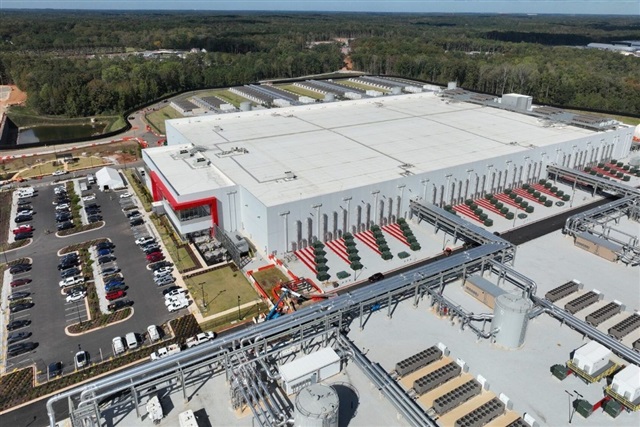
A new front is opening in the race for artificial intelligence infrastructure, and this time it’s not about GPUs or supply chains—it’s about the noise and light a data center emits at night. In Wisconsin, Microsoft is facing a lawsuit brought by residents of Mount Pleasant, who claim the facility generates unbearable acoustic and light pollution, especially during the most intensive training and inference shifts.
The story, while local, signals a structural friction between the hypertrophic growth of mega data centers and their social acceptability. As major cloud providers multiply sites to host increasingly heavy AI workloads, host communities are reckoning with externalities that go beyond water and energy consumption and directly affect daily quality of life.
The social cost of centralized inference
Anyone building LLM pipelines knows that high-intensity inference demands hardware running 24/7, often with forced-air cooling and uninterruptible power supplies that produce a constant background hum. In an on-premise context, these variables are managed internally, with the possibility of acoustically isolating environments and choosing less impactful locations. In cloud mega data centers, however, the logic of aggregate efficiency reduces environmental control to a regulatory compliance issue—and when rules are weak or absent, conflict with residents explodes.
The Wisconsin lawsuit therefore challenges the hyper-centralized deployment model that has dominated the past decade. It’s no longer just about data sovereignty or TCO: social license to operate is now part of the equation, and forward-thinking organizations are beginning to integrate it into risk assessments. For those deciding where to run their models, the legal and reputational pressure surrounding cloud data centers can become an incentive to consider distributed or self-hosted alternatives.
Beyond compliance: proximity as a strategic asset
Historically, the on-premise debate has focused on security, latency, and hardware control. The Wisconsin case suggests a new dimension: the ability to distribute computational load across smaller sites, embedded in urban or industrial fabric, reducing cumulative impact. Fragmented infrastructure—edge, micro data centers, on-premise nodes—not only lowers the disturbance profile but can also better respond to data residency requirements imposed by regulations like GDPR.
Scaling on-premise certainly presents challenges in hardware procurement, in-house skills, and thermal management. Yet the direction is clear: the LLM race can no longer afford to ignore the physical fallout on communities. And when a legal action disrupts a giant like Microsoft, the message for the industry is unmistakable: AI sustainability is not just about PUE or carbon footprint, but also about the ability to coexist with those who live next to the servers.









💬 Comments (0)
🔒 Log in or register to comment on articles.
No comments yet. Be the first to comment!